

The Beating Heart of India’s Financial Markets
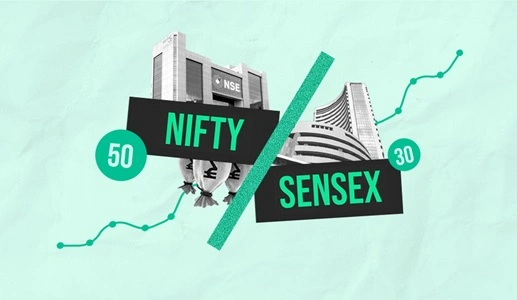
The two iconic indicators of the Indian stock market, the Sensex and the Nifty 50, provide the market’s beat and energy. For many years, these iconic measures have given investors clarity and direction, reflecting the nation’s economic fervor and providing a real-time window into sector sway and broader market sentiment.
Legacy in Numbers: Sensex’s Storied Journey
The Sensex is a live record of the development of the Indian stock market, not just a barometer. It was started in the middle of the 1980s and summarizes the advancements of major industry players in many key areas. In addition to being a selection, the index’s list of 30 significant firms serves as a history of corporate aspirations, allowing investors to see a tale of expansion, resiliency, and rejuvenation.
Precision Calculated: The Science Behind Sensex
The dynamism of contemporary finance is reflected in the Sensex’s calculation. The index provides a genuine representation of investor sentiment free from locked assets by concentrating on shares that are freely transferable. This float-adjusted method ensures that Sensex stays a responsive and relevant indicator for the times by converting abstract numbers into actionable knowledge.
The Curated Club: How Sensex Selects its Champions
Being included to the Sensex is a reflection of a company’s strength and stability rather than a random event. The selection procedure creates an exclusive club that serves as the foundation of India’s industrial and financial might with its exacting standards, which range from consistent liquidity to substantial market capitalization. Twice-yearly evaluations maintain its pulse in line with the realities of the market.
Nifty 50: The Nation’s Panorama in Fifty Frames
Nifty 50 is India’s panoramic lens, capturing the diversity, ambition, and agility of 50 sector-spanning corporate leaders on the National Stock Exchange, if Sensex is the country’s beating heart. Every investor has a share in the country’s ascent to economic prominence thanks to the Nifty 50’s ability to represent the evolving story of entrepreneurship since its establishment.
Calculated for Change: Nifty’s Adaptive Architecture
The Nifty 50’s worldwide aspirations are reflected in its calculation. The index makes sure it stays a versatile and forward-looking indicator by using a float-adjusted, market-cap weighted design and recasting its lineup periodically. The Nifty 50, which is calculated in various currencies, combines local significance with worldwide reach, strengthening its standing as a gauge for both domestic and foreign players.
The Gatekeepers: Nifty 50’s Rigorous Inclusion Ritual
A badge of distinction, joining the Nifty 50 is determined by a stringent screening procedure that emphasizes liquidity, a high trading frequency, and a sizeable free-float market capitalization. The need for readily accessible derivative contracts increases the threshold even further, allowing those businesses whose track record and appeal mirror India’s quickly changing market story to be invited.
The Guiding Lights: Why Investors Look to Sensex and Nifty 50
The Sensex and Nifty 50 are reliable indicators for every market observer and portfolio builder. Their movement conveys much more than just numbers; it captures optimism, highlights changes in the economic winds, and tells the continuous tale of India’s progress. They are used for benchmarking techniques, index fund launches, and as the foundation for derivatives trading.
Closing the Circle: Indices as India’s Ever-Responsive Pulse
The Sensex and Nifty 50 are crucial narratives of Indian capitalism that go beyond simple equations or lists. Investors and analysts may grasp the underlying patterns influencing the country’s economy by dissecting their structure and periodically altering them. These indexes remain vigilant watchdogs, reflecting business, gauging public opinion, and encouraging involvement in the developing story of India’s markets.

Santosh Kumar is a Professional SEO and Blogger, With the help of this blog he is trying to share top 10 lists, facts, entertainment news from India and all around the world.