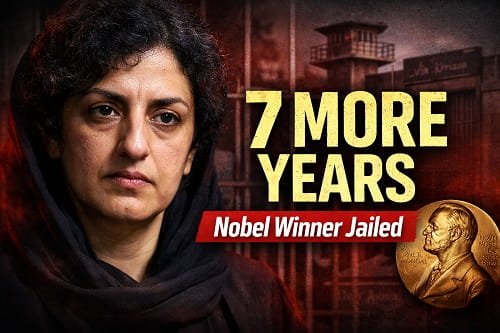
Iran has sentenced Nobel Peace Prize laureate Narges Mohammadi to more than seven additional years in prison, according to her lawyer and supporters, a move that has sparked fresh international outrage and renewed concerns over human rights conditions in the country.
The new sentences come at a particularly sensitive moment, as Mohammadi has reportedly been on a hunger strike since early February, protesting prison conditions and restrictions placed on political prisoners.
Multiple Sentences, Multiple Charges
Mohammadi’s lawyer, Mostafa Nili, confirmed the verdict through social media, stating that the activist received separate sentences in different cases, which together add up to more than seven years. While Iranian authorities have not released a detailed public statement on the latest ruling, such cases typically involve charges linked to national security, propaganda against the state, or participation in human-rights activism.
Supporters argue that these charges are politically motivated and designed to silence one of the most prominent voices advocating for women’s rights and the abolition of the death penalty in Iran.
A Nobel Laureate Behind Bars
Mohammadi was awarded the Nobel Peace Prize in 2023 for her long-standing campaign against the death penalty and for defending the rights of women and political prisoners. At the time of the award, she was already incarcerated, making her recognition a powerful symbol of resistance and international solidarity.
Instead of easing pressure, critics say the Iranian judicial system has continued to tighten restrictions on her, using repeated prosecutions to keep her behind bars for longer periods.
Hunger Strike Raises Alarm
Reports that Mohammadi has been on hunger strike since early February have raised serious concerns among human-rights groups. Hunger strikes in Iranian prisons are often a last resort, used by detainees to protest poor medical care, solitary confinement, or limits on family visits and legal access.
Activists warn that adding years to her sentence while she is refusing food significantly increases the risk to her health and could have irreversible consequences.
Global Reaction and Condemnation
The decision has triggered swift reactions from international organizations, rights groups, and political leaders. Many argue that sentencing a Nobel Peace Prize winner sends a clear message that international recognition does not shield activists from repression inside Iran.
Human-rights organizations say the ruling reflects a broader pattern in which authorities respond to criticism with harsher punishment rather than dialogue or reform.
Iran’s Position
Iranian officials have long rejected accusations that political prisoners are targeted for their views. Authorities maintain that Mohammadi’s convictions are based on violations of Iranian law and insist that the judiciary operates independently.
However, legal experts and observers point out that vague and broadly defined charges allow courts wide discretion, especially in cases involving dissent or activism.
A Broader Message to Activists
Analysts say the renewed sentencing is not only about Mohammadi herself. It is widely seen as a warning to other activists, particularly women who have played a central role in recent protest movements across Iran.
By extending the prison term of one of the country’s most internationally recognized dissidents, authorities appear to be signaling that continued activism will carry severe consequences.
What Comes Next
It remains unclear whether Mohammadi’s legal team will be able to appeal the latest sentences or whether international pressure will lead to any review of her case. For now, her supporters continue to call for her immediate release and for independent monitoring of her health during the hunger strike.
As global attention returns to her case, many observers say it has become a defining test of Iran’s relationship with the international community — and of how far authorities are willing to go to suppress dissent, even when the world is watching.

Satyakam is a seasoned professional content writer with over 15 years of experience in creating high-quality, research-driven content for digital platforms. He specialises in business, finance, banking, law, technology, and informational blogs.