
The phrase “Epstein files” has become shorthand for one of the most disturbing and controversial scandals of modern times. It refers to thousands of pages of court documents, depositions, emails, flight logs, and sealed records connected to convicted sex offender Jeffrey Epstein and his network of powerful associates.
Over the years, pieces of this material have slowly surfaced through lawsuits, media investigations, and court orders. Each release has reignited public outrage — not just over Epstein’s crimes, but over how long he avoided accountability and how many influential figures appeared in his orbit.
So what exactly are the Epstein files? What do they contain? And why are they still causing shockwaves years after Epstein’s death?
Let’s break it down.
Who Was Jeffrey Epstein?
Jeffrey Epstein was a wealthy financier who cultivated relationships with politicians, royalty, academics, and celebrities. Behind that polished image, prosecutors say he ran a sex-trafficking operation that exploited underage girls for years.
In 2008, Epstein avoided federal prosecution through a highly controversial plea deal in Florida, serving just over a year in jail with generous work-release privileges. That agreement, later ruled illegal by a federal judge, allowed him to escape far more serious charges.
He was arrested again in 2019 on federal sex-trafficking charges. Weeks later, Epstein was found dead in his jail cell in what authorities ruled a suicide.
His longtime associate, Ghislaine Maxwell, was later convicted in 2021 for helping recruit and groom minors for Epstein’s abuse network.
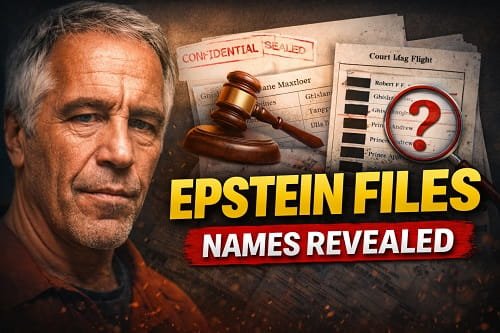
What Are the “Epstein Files”?
The term “Epstein files” isn’t one single document dump. It refers to multiple collections of records released over time, including:
- Court filings from civil lawsuits
- Depositions from Epstein and Maxwell accusers
- Emails and internal communications
- Flight logs from Epstein’s private jets
- Settlement documents
- Witness statements
- Sealed exhibits ordered unredacted by judges
A major recent release came from a defamation case filed by Epstein victim Virginia Giuffre against Maxwell. A New York judge ordered hundreds of previously sealed documents to be made public, exposing names of prominent individuals mentioned in testimony.
Important detail: appearing in these files does not automatically mean someone committed a crime. Many names surfaced because witnesses were asked whether certain people attended events or were known socially. Still, the documents offer an unsettling look into Epstein’s elite circles.
What the Documents Reveal
1. A Web of Power and Influence
The files show Epstein had access to people at the highest levels of society — from politicians and business leaders to academics and royalty. His ability to move freely among powerful circles helped him operate for years without serious scrutiny.
This raises uncomfortable questions about privilege and protection. Critics argue that Epstein’s wealth and connections created a shield that delayed justice.
2. Graphic Accounts from Survivors
Some of the most powerful parts of the files are victim testimonies. Survivors described being recruited as teenagers, flown to Epstein properties, and pressured into sexual acts.
Their statements paint a consistent picture of grooming, coercion, and systematic abuse — often facilitated by staff and associates.
These accounts form the backbone of the criminal cases and civil suits.
3. Flight Logs and Private Islands
Epstein owned multiple properties, including a private island in the Caribbean. Flight records show dozens of trips involving young women and well-known guests.
Again, being on a flight log does not prove wrongdoing. But the travel patterns support allegations that Epstein used his jets and homes as part of his trafficking operation.
4. Failures by Authorities
The files also highlight major institutional failures.
Federal prosecutors later admitted serious errors in Epstein’s 2008 plea deal. The United States Department of Justice acknowledged that victims were illegally kept in the dark about the agreement.
Meanwhile, the Federal Bureau of Investigation faced criticism over missed warning signs and delayed action.
For many observers, this remains one of the most troubling aspects of the case.
Why the Epstein Files Matter
This story isn’t just about one criminal.
It’s about how power intersects with justice.
Epstein’s case exposed how wealth can distort legal outcomes, how victims can be ignored, and how institutions can fail when accountability is inconvenient.
The document releases have forced a wider conversation about:
- Transparency in the legal system
- Victims’ rights
- Prosecutorial discretion
- Elite impunity
They also demonstrate how civil litigation — not criminal prosecution — ultimately brought many facts to light.
What Happened to Ghislaine Maxwell?
Maxwell was convicted in federal court for sex trafficking and conspiracy. She is currently serving a 20-year prison sentence.
During her trial, multiple survivors testified that Maxwell actively recruited girls, normalized abuse, and helped Epstein maintain control over victims.
Her conviction marked one of the few clear legal consequences in the entire saga.
Many critics still ask why no other high-profile figures have been charged.
Why No More Arrests?
This is the question everyone asks.
Prosecutors have said they need direct evidence of criminal conduct, not just associations or social ties. While the files name many individuals, naming alone is not enough to support charges.
Several investigations remain technically open, but years have passed without further indictments.
For Epstein’s victims, that silence feels like unfinished justice.
Public Reaction and Ongoing Pressure
Each new document release sparks renewed anger online and in the media. Advocacy groups continue pushing for full transparency, arguing that all remaining sealed materials should be unredacted.
Some lawmakers have also called for reforms to prevent plea deals like Epstein’s from happening again.
The Epstein files have become a symbol — not just of abuse, but of how systems can fail the vulnerable.
The Bigger Picture
The Epstein case stands as a grim reminder that accountability often arrives late, unevenly, or not at all.
Survivors fought for years to be heard. Much of what we now know came from their persistence, not from proactive law enforcement.
The files show that abuse can hide in plain sight when surrounded by money, status, and silence.
And they leave us with a hard truth: justice doesn’t always move quickly — especially when powerful people are involved.
Final Thoughts
The Epstein files don’t offer neat closure. Instead, they reveal layers of complicity, missed chances, and institutional weakness.
While Epstein and Maxwell have faced consequences, many questions remain unanswered. Who knew what — and when? Why were early warnings ignored? And will the remaining sealed records ever be fully released?
Until those answers come, the Epstein files will continue to haunt public memory — as evidence not only of personal evil, but of systemic failure.

Satyakam is a seasoned professional content writer with over 15 years of experience in creating high-quality, research-driven content for digital platforms. He specialises in business, finance, banking, law, technology, and informational blogs.