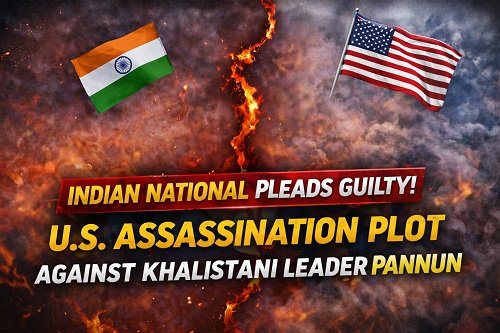
A dramatic and troubling legal milestone took place this week in a federal courtroom in Manhattan, New York. Nikhil Gupta, a 54-year-old Indian citizen, has formally pleaded guilty in the United States to charges connected to an attempted assassination plot against a Sikh separatist leader living in New York. The case has drawn global attention because of its legal, political, and diplomatic implications.
What Did Gupta Admit To?
Gupta stood in a U.S. federal court and admitted guilt on several serious counts, including:
● Murder-for-hire
● Conspiracy to commit murder-for-hire
● Conspiracy to commit money laundering
These charges stem from a plot in 2023 to arrange the killing of Gurpatwant Singh Pannun, an American citizen and leader of a separatist group advocating for a sovereign Sikh state, known as the Khalistan movement.
Gupta’s plea means he acknowledged involvement in planning to recruit someone to carry out this attack in New York City. The punishment for these crimes could be up to 40 years in prison, with the sentencing hearing set for May 29, 2026.
Who Is Gurpatwant Singh Pannun?
Pannun is a U.S.-based Sikh lawyer and activist who has become one of the most visible voices calling for Khalistan — a separate Sikh homeland in northern India. He leads a group called Sikhs for Justice, which has been banned in India for its secessionist goals.
The Indian government labels Pannun a terrorist because of his activism and alleged links to extremist groups. Pannun and his supporters, however, argue that they pursue political and legal avenues to raise awareness about Sikh rights and the demand for independence.
How the Plot Was Uncovered
According to U.S. prosecutors, Gupta was approached in 2023 by an associate tied to a former Indian government employee who claimed to have contacts that could carry out the killing. Gupta agreed to pay for a murder-for-hire operation and delivered a $15,000 advance to someone he thought was a hitman.
In reality, the “hitman” was an undercover agent working with the U.S. Drug Enforcement Administration (DEA). Law enforcement foiled the entire plan before it could be carried out, and Gupta was arrested overseas in the Czech Republic in June 2023. After his extradition to the U.S. in 2024, he was held in jail in Brooklyn.
Bigger Questions Behind the Case
What makes this case far more than a violent crime is its international dimension. U.S. authorities allege Gupta plot was not entirely his own idea, but part of a network involving someone linked to Indian government agencies. The exact nature of official ties has been a focal point of legal and diplomatic debate.
The Indian government has strongly denied state involvement in the plot. Officials argue that any such actions would go against official policy, and they have conducted their own inquiry into how the incident unfolded. They also say the specific government employee referenced by U.S. prosecutors is no longer employed by the Indian government.
U.S. Reaction and Broader Concerns
For the United States, the case sends a clear message that foreign nationals cannot target activists or citizens on American soil with impunity. Prosecutors have stressed that attempting to orchestrate an assassination, even indirectly, is a serious violation of U.S. law and sovereignty.
American officials, including the FBI and Department of Justice, described the plot as a form of transnational repression — meaning efforts by foreign actors to silence or harm dissenters beyond their borders. The legal system’s handling of Gupta’s plea underlines how seriously the U.S. treats such threats.
What Happens Next?
Gupta’s sentence will be determined by a federal judge later this spring, and he could face decades behind bars. The guilty plea also leaves unanswered questions about the wider network behind the plot — and whether any individuals remain at large.
Analysts say the case will continue to be watched closely, not only because of its legal consequences but also for the diplomatic tension it has created between the U.S. and India, especially in the context of global politics and security.
In the end, the Nikhil Gupta case stands at the intersection of law, politics, and international relations. It shows how activism, national security, and justice systems can collide in unexpected ways — and it remains a story unfolding on the world stage.

Satyakam is a seasoned professional content writer with over 15 years of experience in creating high-quality, research-driven content for digital platforms. He specialises in business, finance, banking, law, technology, and informational blogs.