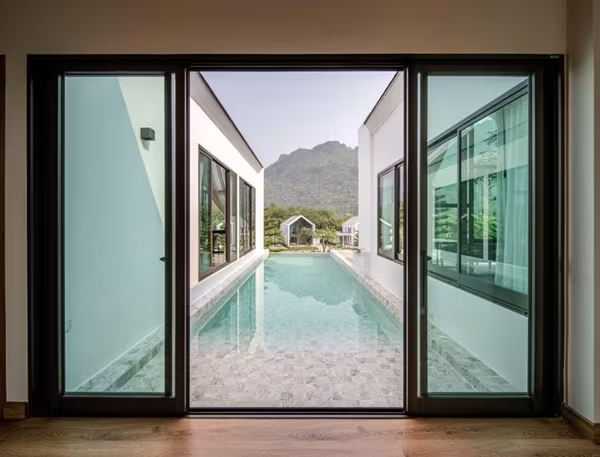
A wall of glass changes how a room feels. They pull in daylight, frame the view, and, when opened, join the living room to the balcony, terrace, or garden. Large aluminium sliding doors are one of the most practical ways to get there.
They open without swinging into the room, carry wide glass panels in slim frames, and can be laid out to clear a large share of the wall. Here is how they work, which layouts suit which openings, and what to plan before you install one.
Why sliding doors suit wide openings
A hinged door needs clear floor space to swing open, and the wider the door, the bigger that arc becomes. Across a whole wall, swing doors would eat into furniture space on one side and the balcony on the other.
Sliding doors avoid this entirely. Each panel moves along a track parallel to the wall, so the floor in front stays usable whether the door is open or shut.
They also suit how Indian homes are used. Balcony and living room doors open many times a day, often by children and older family members, and a sideways-sliding panel is easier to manage than a large swinging leaf.
How panels and tracks decide the opening
The clear opening depends less on wall width than on how the panels and tracks are arranged. Panels stack behind one another as the door opens, so the number of tracks determines how much wall space you can clear.
- 2 panels on 2 tracks: one panel slides behind the other, opening roughly half the width. This suits standard balcony and bedroom doors.
- 3 panels on 3 tracks: each panel has its own track, so two can stack behind the third and open about two-thirds of the width.
- 4 panels on 2 tracks: four panels share two tracks, a common choice for wide living room and patio openings.
- 6 panels on 3 tracks: six narrower panels share three tracks, which keeps each panel a manageable size on very wide walls.
More panels also means narrower, lighter panels, so the door stays easy to slide even when the whole unit spans several metres.
Before choosing a layout, think about where the panels will stack. That part of the wall stays covered by glass when the door is open, so keep sofas, planters and lamps clear of it.
Corner sliding doors
Where two walls of a room both face a balcony or garden, a corner sliding door can open them at once. Two sets of panels meet at the corner and slide away from it in opposite directions.
When both sides slide back, the corner is left completely open, and the room and the outdoor space read as one. This works especially well for corner living rooms, wraparound balconies and villas with a garden on two sides.
Must Read:- 10 Stunning Aluminium Door Design Ideas for a Modern Entrance
Why aluminium suits large glass panels
Big glass panels are heavy, and the frame has to hold them square for years. Aluminium is strong for its weight, so frames can stay slim while still carrying wide panels. Slimmer frames mean more of the wall is glass, which is why a slim-profile aluminium door design works so well for a glass wall.
Aluminium also handles Indian conditions well. It does not warp or swell in humid monsoon weather the way timber can, and anodised aluminium resists corrosion, which matters in coastal cities.
Upkeep is simple. Wipe the frames now and then, keep the tracks free of dust, and the door should keep sliding smoothly.
What to plan before installation
A large sliding door is part of the building, not just a fitting, so it’s best to make a few decisions early.
- Measure accurately: The layout and panel sizes depend on the opening’s exact width and height.
- Check the structure above: The beam or lintel has to carry the load across a wide span without sagging.
- Plan the threshold and drainage: Balcony tracks need to shed rainwater, especially in areas with heavy monsoons.
- Choose the glass: Toughened or laminated glass adds safety on large panels, and tinted glass can cut heat on sunny walls.
- Ask about locks and mesh: Check the locking options for your layout, and whether you need an insect mesh.
- Leave room for stacking: Plan furniture around the section where the panels will sit when the door is open.
Settling these points before work begins avoids costly changes later and helps the door perform well for years.
For large openings, manufacturers such as TOSTEM offer aluminium sliding doors built with Japanese technology, in layouts from 2 panels on 2 tracks to 6 panels on 3 tracks, along with corner and entrance sliding doors. Every frame is anodised and protected by the patented TEXGUARD coating, which keeps its colour and lustre for at least 40 years. The doors are tested to JIS, ASTM and BS standards for wind, air, water and noise, so they perform reliably in every Indian climate, from coastal cities to hill towns.
Conclusion
A large sliding door is one of the simplest ways to turn a solid wall into a view. The right choice comes down to the opening width, how much you want to clear, and how the room is furnished around it. It is worth seeing a few layouts in person before you decide. Chosen well, the door will slide easily, keep out the weather and make the whole room feel far more open.

Santosh Kumar is a Professional SEO and Blogger, With the help of this blog he is trying to share top 10 lists, facts, entertainment news from India and all around the world.