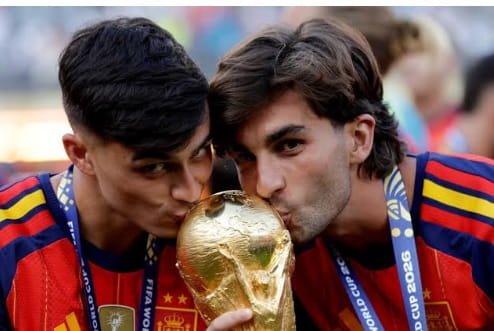
Spain returned to the summit of world football after defeating defending champions Argentina 1-0 in the FIFA World Cup 2026 final. A tense contest at the New York New Jersey Stadium remained goalless for 105 minutes before substitute Ferran Torres produced the decisive finish.
The victory gave Spain their second men’s World Cup title, 16 years after Andrés Iniesta’s extra-time goal secured their first trophy in 2010. Argentina’s dream of winning consecutive World Cups ended in disappointment, while Lionel Messi’s likely final appearance in the tournament closed without the fairytale finish many expected.
Spain Dominated but Argentina Held Firm
Spain controlled possession from the beginning, with Rodri, Fabián Ruiz and Dani Olmo dictating the tempo in midfield. Lamine Yamal and Mikel Oyarzabal tried to stretch Argentina’s defence, but goalkeeper Emiliano Martínez repeatedly prevented Spain from taking the lead.
Argentina adopted a cautious approach. Lionel Scaloni’s team defended deep and attempted to disrupt Spain’s passing rhythm through physical challenges. Messi and Julián Álvarez received very little service, leaving Argentina without a single shot during the regulation 90 minutes—the first time this had happened to a team in a men’s World Cup final.
Spain finished the match with 20 attempts, including 12 on target, while Argentina recorded only two attempts and none on target. Martínez’s outstanding saves kept the defending champions alive until extra time.
Enzo Fernández’s Red Card Changes the Final
Argentina’s task became considerably harder when Enzo Fernández received his second yellow card during stoppage time at the end of the regulation period. His dismissal left Argentina with ten players for extra time.
Spain coach Luis de la Fuente turned to his substitutes, introducing Nico Williams and Ferran Torres. Their pace and movement gave Spain the attacking sharpness that had been missing during the opening 90 minutes.
Ferran Torres Scores the World Cup-Winning Goal
The breakthrough finally arrived in the 106th minute. Pedro Porro sent a cross into the penalty area, Nico Williams kept the move alive with a header, and the ball dropped invitingly for Torres.
The substitute struck a controlled first-time left-footed shot beyond Martínez to make it 1-0. It was Spain’s 20th attempt of the final and the only goal needed to win the trophy.
Torres later appeared to score again, but his second effort was disallowed. Argentina tried to respond in the closing minutes, yet Spain’s defence remained organised and goalkeeper Unai Simón was never forced into a meaningful save.
Disappointing End for Lionel Messi
At 39, Messi became only the second player after Brazil’s Cafu to appear in three World Cup finals. However, Spain prevented him from influencing the match.
Despite the defeat, Messi enjoyed an exceptional tournament, scoring eight goals and providing four assists. He received the Silver Ball as the competition’s second-best player. Emotions spilled over after the final whistle, with a confrontation between players resulting in Leandro Paredes being shown a red card after the match.
Spain’s Road to the World Cup Title
Spain topped Group H with two victories and one draw. They then defeated Austria 3-0 in the round of 32, Portugal 1-0 in the round of 16, Belgium 2-1 in the quarter-final and France 2-0 in the semi-final.
Argentina won all three Group J matches before overcoming Cape Verde 3-2 after extra time, Egypt 3-2, Switzerland 3-1 after extra time and England 2-1.
Spain conceded only one goal in eight matches and recorded seven clean sheets. Their final victory also extended their unbeaten run to 38 games. De la Fuente, who guided Spain to Euro 2024 glory, became the oldest World Cup-winning coach at 65. Spain also became the first country to hold the men’s and women’s World Cup titles simultaneously.
FIFA World Cup 2026 Award Winners
Kylian Mbappé won his second consecutive Golden Boot after scoring ten goals for France—the highest total at a men’s World Cup since Gerd Müller in 1970.
- Golden Boot:Kylian Mbappé, France – 10 goals
- Golden Ball:Rodri, Spain
- Silver Ball:Lionel Messi, Argentina
- Bronze Ball:Kylian Mbappé, France
- Golden Glove:Unai Simón, Spain
- Best Young Player:Pau Cubarsí, Spain
- FIFA Fair Play Trophy:Netherlands
Rodri’s control and leadership earned him the Golden Ball, while Simón’s seven clean sheets secured the Golden Glove. Nineteen-year-old defender Pau Cubarsí completed Spain’s remarkable awards haul by being named the tournament’s best young player.

Satyakam is a seasoned professional content writer with over 15 years of experience in creating high-quality, research-driven content for digital platforms. He specialises in business, finance, banking, law, technology, and informational blogs.