Nearly nine years after first introducing its next-generation Roadster, Tesla has finally unveiled a redesigned version of the electric sports car, complete with rocket-inspired technology developed alongside SpaceX. The October 15, 2026, demonstration in Texas showcased a vehicle capable of accelerating at extraordinary speeds, driving upside down and briefly launching itself into the air.
The dramatic presentation marked a significant moment for Tesla CEO Elon Musk, who has repeatedly promised that the Roadster would redefine automotive performance. However, the unveiling also raised questions beyond the car itself. The increasingly visible engineering relationship between Tesla and SpaceX has renewed speculation about a possible merger of the two Musk-led companies.
Despite the excitement surrounding the demonstration, the Roadster remains a prototype, with production now scheduled for 2028. Its commercial prospects, road legality and broader implications for Tesla’s future are still uncertain.
Tesla Roadster Makes a Dramatic Debut in Texas
Tesla presented the redesigned Roadster at a SpaceX testing facility in McGregor, Texas, near Waco. Unlike a conventional automotive unveiling, the event featured a series of maneuvers designed to demonstrate capabilities rarely associated with passenger vehicles.
During the livestreamed presentation, a white Roadster drove along an inverted ramp using a suction system that helped keep it attached to the surface. It then launched into the air, rotated and landed on its wheels with assistance from integrated thrusters.
Another demonstration showed the vehicle briefly lifting itself over several Tesla vehicles, including a Cybertruck and Cybercab.
The event demonstrated the unusual engineering behind the car, although it did not establish that the Roadster can perform sustained flight like an aircraft.
For Tesla, the spectacle served another purpose: reviving attention around a project whose repeated delays had raised doubts about whether it would ever reach production.
How SpaceX Technology Makes the New Roadster Different
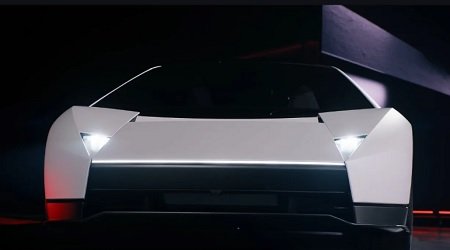
The redesigned Roadster incorporates technology developed through cooperation between Tesla’s automotive engineers and SpaceX’s aerospace specialists.
Its most unusual feature is a cold-gas thruster system that uses highly pressurized gas to generate bursts of force. Unlike a conventional rocket engine, which burns propellant, the system relies on releasing compressed gas through strategically positioned nozzles.
The technology can provide additional thrust for acceleration and help control the vehicle’s movement during brief airborne maneuvers. Combined with a suction mechanism and other vehicle-control systems, it enabled the prototype’s upside-down driving and aerial demonstrations.
This approach represents a departure from conventional electric sports cars, which primarily depend on battery performance, electric motors, traction and aerodynamics.
Nevertheless, the distinction between a vehicle capable of short powered jumps and a practical flying car remains important. Tesla has demonstrated the former, but sustained airborne transportation has not been established.
Tesla Roadster Performance: Speed, Acceleration and Range
Tesla’s latest performance claims place the Roadster among the most ambitious electric sports cars announced to date.
According to specifications presented at the unveiling, the vehicle offers:
- Acceleration:0–60 mph in less than one second.
- Top speed:More than 230 mph (approximately 370 km/h).
- Driving range:More than 300 miles (approximately 480 km) per charge.
- Propulsion technology:Electric powertrain with SpaceX-developed thrusters on specialized versions.
- Production target:
These figures are manufacturer claims rather than independently verified specifications for a production vehicle.
Interestingly, the newly stated driving range is substantially lower than Tesla’s original promise of more than 600 miles when the second-generation Roadster was introduced in 2017.
Tesla has also outlined different Roadster configurations. Its Performance version requires a $50,000 reservation deposit, while the thruster-equipped Thrust version requires a $250,000 deposit. A more extreme, single-seat Rocket configuration featuring a fuller flight system is listed as invitation-only.
The company did not announce a finalized purchase price at the unveiling. Reservation deposits should not be confused with the vehicle’s eventual selling price.
Why Has the Tesla Roadster Been Delayed for So Long?
Tesla originally introduced the second-generation Roadster in November 2017, promising a high-performance electric sports car that would enter production around 2020.
That deadline passed without deliveries, followed by several revised timelines as the company concentrated on higher-volume vehicles and other projects.
The first Tesla Roadster, produced between 2008 and 2012, helped establish the company’s identity by showing that electric vehicles could offer serious performance rather than merely serving as economical alternatives to gasoline-powered cars.
The new Roadster was intended to build on that legacy by becoming Tesla’s technological flagship.
However, Tesla’s priorities have changed considerably since 2017. The company has increasingly emphasized autonomous driving, robotaxis, artificial intelligence and humanoid robotics rather than simply expanding its conventional vehicle lineup.
The latest 2028 production target consequently represents another substantial wait for reservation holders. Tesla must still convert its demonstration vehicle into a manufacturable product while addressing safety, cost and regulatory requirements.
Tesla-SpaceX Collaboration Fuels Merger Speculation
Beyond the Roadster’s performance, its development has intensified discussion about whether Tesla and SpaceX could eventually operate under a common corporate structure.
Both companies are led by Elon Musk and have increasingly overlapping interests in advanced manufacturing, software, artificial intelligence and complex engineering systems.
The Roadster provides a visible example of those connections. Tesla’s electric vehicle expertise has been combined with propulsion and control technologies associated with SpaceX, producing a vehicle that neither company would ordinarily develop on its own.
Technology analyst Dan Ives described the demonstration as evidence of a deeper engineering relationship between the businesses. He has previously argued that combining Tesla and SpaceX could create a powerful technology enterprise.
Tesla investor Gene Munster also interpreted the unveiling as another indication of Musk’s interest in bringing the companies closer together.
Nevertheless, no merger agreement was announced at the Roadster event. Analysts’ expectations and public speculation should not be mistaken for a confirmed corporate transaction.
Any potential combination would involve substantial financial, legal and governance questions, including valuation, shareholder interests and regulatory scrutiny. Cooperation on a single vehicle does not, by itself, establish that a merger is imminent.
Can the New Tesla Roadster Legally Fly on Public Roads?
One of the biggest unanswered questions concerns the practical use of the Roadster’s airborne capabilities.
Although the demonstration showed the vehicle performing controlled jumps and aerial rotations, such maneuvers raise significant safety and regulatory concerns when considered for public roads.
Tesla’s own product information states that its specialized Rocket configuration is not approved for public road use.
Authorities would need to assess issues including vehicle stability, pedestrian safety, operating restrictions and the risks posed by high-pressure propulsion systems before similar features could become suitable for ordinary transportation.
The prototype’s successful demonstration therefore should not be interpreted as approval for unrestricted flying or jumping on public streets.
What the Roadster Means for Tesla’s Business Strategy
The Roadster arrives during an important transition for Tesla, as the company seeks to establish itself as more than an electric vehicle manufacturer.
Its ambitions now extend to autonomous transportation, the Cybercab robotaxi platform, artificial intelligence and the Optimus humanoid robot.
Within that broader strategy, the Roadster is unlikely to become a major source of sales volume. Instead, it could serve as a halo car, demonstrating engineering capabilities and strengthening the company’s reputation for technological experimentation.
Musk has previously acknowledged that the Roadster is not expected to make a major financial contribution to Tesla.
The market initially responded positively to the unveiling, with Tesla shares rising in premarket trading on October 16. However, analysts have emphasized that profitability, cash flow and progress in Tesla’s core businesses will carry more financial weight than a limited-production sports car.
Tesla’s scheduled third-quarter earnings announcement on October 21, 2026, will provide a more immediate assessment of its operating performance.
What Happens Next for the Tesla Roadster?
The October unveiling answered one longstanding question: Tesla has developed a working prototype with the extraordinary capabilities Musk has discussed for years.
It has not, however, settled the question of when customers will receive their vehicles.
The next important developments will include confirmation of production specifications, final pricing, safety approvals and evidence that Tesla can manufacture the Roadster at its intended scale.
The SpaceX collaboration may also continue to attract attention from investors interested in a closer relationship between Musk’s businesses. For now, however, that possibility remains speculative.
The Roadster’s greatest achievement so far is its engineering demonstration. Its lasting significance will depend on whether Tesla can turn that spectacle into a commercially available vehicle by its latest 2028 target.

Satyakam is a seasoned professional content writer with over 15 years of experience in creating high-quality, research-driven content for digital platforms. He specialises in business, finance, banking, law, technology, and informational blogs.