
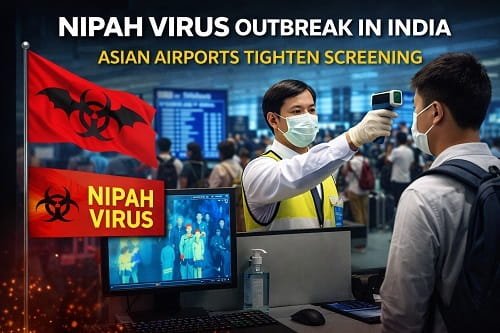
A cluster of recent Nipah virus infections detected in West Bengal has put several Asian countries on alert. Airports from Thailand to Taiwan and Nepal have reintroduced Covid-style screenings and stepped up surveillance for passengers arriving from India. The move is precautionary, but it reflects how seriously public-health authorities treat Nipah: a zoonotic virus that can cause severe brain inflammation and carries a high fatality rate.
What happened and who is affected
Local health authorities in West Bengal reported multiple suspected and confirmed Nipah cases in late January 2026, and nearly a hundred close contacts have been quarantined as officials trace links and possible exposures. The outbreak is being treated urgently because of Nipah’s past pattern of severe illness and the risk of person-to-person spread in certain settings.
Several Asian airports have reintroduced frontline checks — temperature screening, travel-history questions, and symptom questionnaires — for passengers arriving from India or transiting through affected regions. Authorities say these measures are meant to identify symptomatic travellers early, not to alarm the public. Still, travellers should expect longer processing times and possible secondary health checks on arrival.
What Nipah virus is — and why it worries health experts
Nipah virus (NiV) is an emerging paramyxovirus first recognized in 1998–1999. It is zoonotic, meaning it normally circulates in animals — especially fruit bats — and jumps to humans through direct contact with infected animals, contaminated food, or, in some outbreaks, through infected pigs. Human-to-human transmission has been documented in several outbreaks.
Clinically, infections range from mild flu-like illness (fever, headache, myalgia, vomiting, sore throat) to severe respiratory disease and fatal encephalitis (brain swelling). Survivors may face long-term neurological problems. Past outbreaks have shown a high case fatality ratio, varying by outbreak and local clinical capacity; some events recorded mortality rates well above 40-70 percent. There is no widely available licensed vaccine or proven antiviral therapy for Nipah yet, which is why containment relies heavily on rapid detection and classical public-health measures.
How Nipah spreads — simple precautions that work
Transmission routes include:
- Direct contact with infected bats, pigs, or other animals.
- Consuming fruit or sap contaminated by bat saliva or urine.
- Close contact with an infected person’s bodily fluids (droplets, secretions) in household or healthcare settings.
Basic precautions go a long way. Avoid raw date palm sap or fruit that may have been partially eaten by bats; wash fruits thoroughly; avoid close contact with symptomatic people; and if you’re a healthcare worker, use personal protective equipment stringently. These practical steps reduce risk while authorities do contact tracing and testing.
Why airports are reintroducing checks — and what they can (and can’t) do
Airports can screen for symptomatic travellers and collect travel histories, which helps slow cross-border spread. But many Nipah cases begin with non-specific symptoms similar to common viral illnesses; asymptomatic or pre-symptomatic travellers can pass through screening undetected. So airport checks are one layer of defense — valuable, but not foolproof. Health screening buys time for contact tracing and public awareness campaigns; it does not replace clinical surveillance and laboratory testing.
Practical advice for travellers
If you must travel to or from affected areas:
- Monitor your health for 21 days after possible exposure (the incubation period can vary).
- Carry proof of travel and be ready to answer questions about recent locations visited.
- Seek prompt medical attention if you develop fever, cough, severe headache, or neurological symptoms — and tell clinicians about recent travel.
- Follow local health authority instructions regarding testing or quarantine.
The bigger picture: vigilance, not panic
Nipah’s high case fatality and its ability to jump from animals to humans rightly trigger concern. But public-health responses today are faster and more coordinated than in the past: surveillance systems, lab networks, and contact tracing are often robust at the local and regional level. The immediate goals are containment, protecting healthcare workers, and preventing the virus from seeding sustained chains of community transmission.
Conclusion
The West Bengal Nipah cases are a reminder that zoonotic threats remain a constant global challenge. Airport screenings and heightened surveillance across Asia are sensible early steps to limit cross-border spread. For travellers, sensible hygiene, honest travel histories, and quick medical attention for symptoms are the best personal defenses. Public cooperation and transparent, rapid public-health action will determine whether this outbreak is contained quickly or becomes a broader concern.

Satyakam is a seasoned professional content writer with over 15 years of experience in creating high-quality, research-driven content for digital platforms. He specialises in business, finance, banking, law, technology, and informational blogs.