
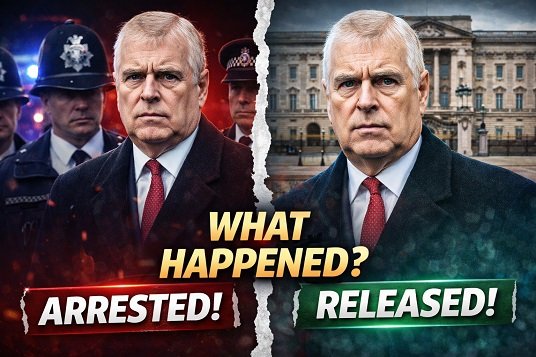
When police moved in early on February 19, 2026, to detain former Prince Andrew, now Andrew Mountbatten-Windsor, it marked one of the most dramatic legal moments in decades involving a senior British royal. What began with bombshell dispatches from the U.S. Department of Justice — commonly referred to as the Epstein files — ended with his arrest on suspicion of misconduct and his release hours later under investigation. It has sent shockwaves through Britain and around the globe.
Let’s break down how it unfolded, why authorities took the unprecedented step, and what his release means next.
The Arrest: A Royal Taken Into Custody
On February 19, 2026 — his 66th birthday — Andrew was arrested early in the morning at his home on the Sandringham estate in Norfolk by officers from Thames Valley Police. The charge? Suspicion of misconduct in public office related to his ties with convicted sex offender Jeffrey Epstein.
Police did not name him at the time, following UK practice, but later confirmed that he was being questioned about whether he used his official position more than a decade ago to share confidential information with Epstein — who was jailed in the U.S. for sex crimes involving children.
Unmarked police vehicles arrived at Wood Farm, his residence at Sandringham, and carried out searches at both that property and his former home, Royal Lodge in Windsor. Investigators were seen moving through rooms and examining documents.
It was the first time in nearly 400 years that a senior member of the British royal family had been arrested — an extraordinary moment reflecting intensified scrutiny of his actions and longstanding ties to Epstein.
The Allegations: What Police Are Investigating
The immediate suspicion centers on misconduct in public office, an old but serious common-law offence in England and Wales. It can carry a life sentence if prosecutors prove that a public official knowingly abused their authority.
A key focus for police are emails and documents included in the recently released Epstein files that appear to show:
● He forwarded government trade reports and details from official UK trade missions to Epstein in 2010 and 2011.
● Some of these reports originated from his role as Britain’s Special Envoy for Trade and Investment — a position that required confidentiality and probity.
● Officers are considering whether these actions crossed legal lines and constituted misuse of his public role.
These fresh revelations reopened the spotlight on long-standing concerns about his association with Epstein — concerns that previously damaged his reputation and forced him to step back from public life.
A Royal Family Responds: King Charles Speaks
Buckingham Palace was reportedly not informed before the arrest, amplifying the shock across royal circles. Nonetheless, King Charles III issued a rare public statement urging respect for the process and emphasizing that “the law must take its course.”
In acknowledging his brother’s legal situation, the king underlined the monarchy’s support for the authorities and pledged full cooperation in the unfolding investigation. Senior members of the royal family, including Queen Camilla, also continued with official engagements amid the ongoing scrutiny.
Release Under Investigation: What That Means
After roughly 11–12 hours in custody, Andrew was released “under investigation” late Thursday evening. This status means he has not been charged with any crime — and he is free while police continue inquiries.
Being released under investigation also signals that authorities believe they have enough evidence to look deeper, but not enough (at this stage) to pursue criminal charges. The police are still analyzing documents, questioning witnesses, and reviewing evidence collected in the searches.
Importantly:
● Release under investigation is not an exoneration.
● It means the case remains active, and charges could still be pursued months or even years later, depending on findings.
Beyond the Arrest: Historical Context and Ongoing Fallout
This isn’t the first time Andrew’s link to Epstein has caused major upheaval. In previous years:
● He was forced to step down from public royal duties after a widely panned BBC interview in 2019.
● He settled a civil lawsuit with one of Epstein’s primary accusers in 2022, with no admission of liability.
● In late 2025, King Charles oversaw the removal of all his royal titles and honours amid intensifying scrutiny.
Even after shedding titles, he remained eighth in the line of succession — a distinction that adds weight to what many see as an extraordinary legal moment for British royalty.
Reactions: Law, Media, and Public Voices
Responses to the arrest and release have been wide-ranging:
● Legal experts note that misconduct in public office is difficult to prove, especially at this level of prominence, but say the police action signals serious intent.
● Critics of the monarchy see the arrest as long-overdue accountability for powerful figures.
● Supporters argue that legal systems are rightly probing serious allegations, and that due process must play out fairly before any judgment is reached.
What Happens Next
At this point:
● Investigators will continue examining evidence collected from searches.
● Police may question additional witnesses and experts.
● Prosecutors will review findings to decide whether formal charges are warranted.
● The public will be watching closely as one of the most prominent figures in recent royal history navigates an unprecedented legal situation.
For now, Andrew is free but under legal scrutiny — and the case has opened a new chapter in the long-running saga of Epstein revelations and their global impact.

Satyakam is a seasoned professional content writer with over 15 years of experience in creating high-quality, research-driven content for digital platforms. He specialises in business, finance, banking, law, technology, and informational blogs.