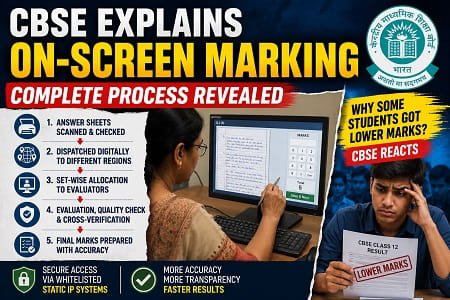
The Central Board of Secondary Education has explained the complete process followed under its newly introduced On-Screen Marking (OSM) system for the 2026 Class 12 board examinations. The clarification comes after some students and parents raised concerns on social media regarding lower-than-expected marks after the declaration of results.
CBSE stated that the digital evaluation system was introduced to make the checking process more secure, transparent and accurate while reducing the chances of human error during marking and result preparation.
How The OSM Process Begins
According to the board, the evaluation process starts with the receipt and secrecy stage. During this stage, answer books are collected and coded by external experts so that the identity of students remains hidden from evaluators.
After coding, answer sheets are scanned using high-quality scanners. CBSE said a first-level quality check is conducted immediately after scanning by the agency team. If any scanned copy appears unclear or incomplete, the answer sheet is scanned again to ensure proper visibility before evaluation begins.
Digital Dispatch To Different Regions
Once the scanning process is completed, the digital copies of answer books are sent to different regional evaluation centres across the country. CBSE clarified that scanned answer sheets are not evaluated in the same region where the examination was conducted. This step has been introduced to maintain confidentiality and strengthen fairness in evaluation.
The board also stated that evaluation centres are provided access only through whitelisted static IP systems. This secure access mechanism is aimed at preventing unauthorised entry into the digital evaluation platform.
How Teachers Evaluate Answer Sheets
Under the OSM system, answer books are arranged set-wise and allotted to evaluators online. Instead of checking physical copies, teachers assess scanned answer sheets directly on the digital platform and award marks online.
CBSE said another quality check takes place during the marking process itself. If evaluators notice any issue in the scanned answer book, they can reject the copy with comments. Necessary corrective steps are then taken before evaluation resumes.
After evaluators complete the marking process, the answer sheets are cross-checked by Assistant Head Examiners (AHE) and Head Examiners (HE). This is done to ensure consistency, fairness and accuracy in awarding marks.
Training And Rollout Before Implementation
CBSE also shared details about the preparation carried out before implementing the OSM system nationwide.
The board conducted a dry run on January 20 and 21, 2026, in five schools involving nearly 100 teachers. Demonstration sessions and feedback collection started from February 9 onwards, during which teachers were trained and suggestions were reviewed.
A nationwide webinar on the OSM system was conducted on February 13 and attended by schools and teachers from different parts of the country. Later, on February 15, evaluators were provided portal access to practise checking previous years’ answer books digitally.
The actual evaluation work under the OSM system officially started on March 7, 2026.
Students Raise Concerns After Results
CBSE has maintained that the On-Screen Marking system reduces totalling mistakes, tabulation errors and inconsistencies in marking while also helping in faster result processing.
However, after the announcement of Class 12 board results, several students and parents expressed concerns online, claiming they had received lower marks than expected under the new digital evaluation system.
Despite the criticism, CBSE continues to defend the OSM model, saying the system includes multiple levels of verification and monitoring to ensure reliable evaluation standards.

Satyakam is a seasoned professional content writer with over 15 years of experience in creating high-quality, research-driven content for digital platforms. He specialises in business, finance, banking, law, technology, and informational blogs.