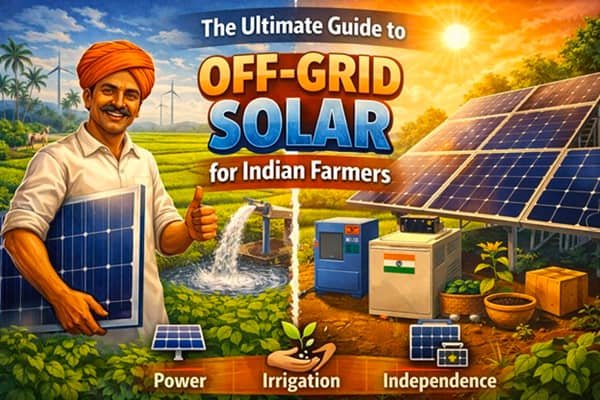
Agriculture remains the backbone of the Indian economy, yet many farmers continue to face challenges related to erratic power supply and high diesel costs for irrigation. An off-grid solar system provides a sustainable solution by allowing farmers to generate their own electricity independently of the central grid. In 2026, the integration of advanced technology and supportive government schemes like PM-KUSUM has made decentralized solar power more accessible than ever. By adopting these systems, rural communities can ensure reliable irrigation, reduce operational expenses, and contribute to the national goal of decarbonizing the agricultural sector through clean, renewable energy.
Understanding the Off-Grid Solar System in Indian Agriculture
An off-grid solar system is a standalone power unit that operates independently of the local utility grid. For an Indian farmer, this typically consists of solar modules, a solar pump controller, and an optional battery energy storage system. Unlike on-grid systems, these units are ideal for remote regions where grid extension is either physically difficult or too expensive. By capturing sunlight during the day, these systems power irrigation pumps directly or store energy for use at night.
In 2025, India’s renewable energy capacity reached a significant milestone, with solar power contributing 130 GW to the national mix. This growth has been supported by a transition to high-efficiency modules, such as N-type TOPCon technology, which provides better performance in the high-temperature conditions typical of Indian farmlands. These advancements ensure that even small-scale installations can deliver high water discharge rates.
Independent power generation eliminates the uncertainty of rural load-shedding schedules.
PM-KUSUM Scheme: 2026 Updates and Benefits for Farmers
The Pradhan Mantri Kisan Urja Suraksha evam Utthaan Mahabhiyan (PM-KUSUM) remains the most vital policy for rural solar adoption. As of early 2026, the scheme has been expanded to reach more remote clusters. The primary focus of the scheme is to de-dieselize the farm sector by providing substantial financial assistance for the installation of standalone solar pumps.
| Component | Target Application | Subsidy Structure (Indicative) |
| Component B | Standalone Solar Pumps | 60% (30% Central + 30% State) |
| Component C | Solarization of existing pumps | 60% Subsidy on solar components |
Note: In North-Eastern and Hilly states, the central subsidy can reach up to 50%.
Under the 2026 updates, the government has streamlined the application process through a single-window digital portal. Farmers can now track their application status and subsidy disbursements in real time, reducing administrative delays. Furthermore, the mandatory use of high-efficiency domestic modules ensures that the equipment is rugged enough for decade-long use in open fields.
Government support significantly reduces the initial capital requirement, making solar a viable choice for smallholder farmers.
The Role of Battery Energy Storage System (BESS) in Rural Power
While solar pumps often run directly on sunlight, many modern farming operations require power beyond daylight hours, for lighting, cold storage, or domestic use. This is where a battery energy storage system becomes essential. By integrating a battery energy storage system, farmers can store surplus electricity generated during the afternoon and use it at night.
The Indian government has recognized the importance of storage, targeting a capacity of 43,220 MWh under the Viability Gap Funding (VGF) schemes for BESS. For a farmer, this technology means:
- Night-time Irrigation: Flexibility to water crops during cooler hours to reduce evaporation.
- Cold Chain Support: Running small-scale refrigeration units to prevent post-harvest losses.
- Grid Backup: Acting as a reliable power source for farmhouses during local grid failures.
Storing energy transforms a daylight-only resource into a versatile, round-the-clock power utility.
Technical Considerations: Why Technology Choice Matters
The efficiency of an off-grid solar system depends heavily on the quality of its components. In the current market, N-Type TOPCon modules are replacing older technologies because they offer cell efficiencies of 25%-26%. For a farmer, higher efficiency means more water pumped with fewer panels, which is critical when roof or ground space is limited.
Choosing modules with a high wattage, such as those in the 600Wp to 700Wp class, allows for faster installation and fewer mounting structures. High-quality manufacturers like Avaada provide these advanced TOPCon modules, ensuring that rural installations can withstand harsh dust and wind conditions. These modules are designed to maintain high output even during the hazy winter months often seen in North India.
Precision in component selection ensures the maximum return on every watt of solar power generated.
Must Read:- Solar Panel Types for Small Roofs
Economic Impact and Long-Term Savings
Switching to a solar-powered irrigation system immediately reduces input costs. Diesel prices remain a volatile expense for farmers using traditional pumps. A 5 HP solar pump can save thousands of liters of diesel annually, paying for its non-subsidized portion within 3 to 5 years.
According to NITI Aayog’s recent scenarios for “Viksit Bharat,” decentralized renewable energy is a pillar for rural economic upliftment. By eliminating monthly fuel or electricity bills, farmers can reinvest those savings into better seeds, fertilizers, or livestock, improving their overall quality of life. Moreover, surplus energy can sometimes be sold back to the grid in “Grid-Connected” versions of the scheme, providing an additional revenue stream.
Financial independence from fossil fuels creates a more predictable and profitable agricultural cycle.
Final Thoughts
The adoption of an off-grid solar system is a transformative step for Indian agriculture. With the 2026 updates to the PM-KUSUM scheme and the declining costs of battery energy storage systems, the barriers to entry have never been lower. High-efficiency modules, such as those produced by renewable energy companies like Avaada, ensure that these systems are not just temporary fixes but long-term assets for the farm. As India moves toward a greener future, empowering farmers through clean energy will remain at the heart of the nation’s progress.

Santosh Kumar is a Professional SEO and Blogger, With the help of this blog he is trying to share top 10 lists, facts, entertainment news from India and all around the world.