
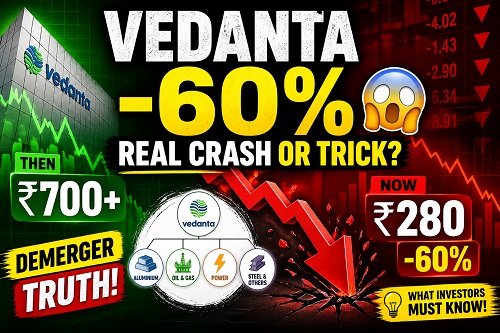
The recent headline about Vedanta Limited shares tumbling more than 60% has created panic among many investors. At first glance, it looks like a massive crash. But the reality is very different. This sharp fall is not due to poor performance or bad news. It is a direct result of the company’s demerger process.
Let’s break it down in a simple way so you can clearly understand what actually happened and what it means for investors.
What Happened on the Ex-Demerger Date?
On April 30, 2026, Vedanta shares started trading on an ex-demerger basis. This means the stock price was adjusted to reflect only the value of the remaining core business.
Before this date, Vedanta’s share price included the combined value of multiple businesses such as aluminium, oil and gas, power, and steel. Once the demerger took effect, these divisions were separated into different entities. As a result, their value was removed from the main share price.
This is why the stock appeared to fall from around ₹700+ levels to nearly ₹280–₹300. It wasn’t a real crash. It was a price adjustment.
Why the Share Price Dropped So Much
The key reason behind the 60% fall is simple:
the company is no longer the same structure as before.
Think of it like this:
- Earlier: 1 Vedanta share = value of all businesses combined
- Now: 1 Vedanta share = value of only one part of the business
The remaining value is not lost. It is just split into separate shares of new companies that investors will receive.
So the price drop reflects a smaller company, not a weaker one.
What Investors Will Receive
As part of the demerger, shareholders of Vedanta will receive shares in the newly created companies. The structure is designed so that investors continue to hold ownership across all business segments, but in separate listed entities.
This means if you owned 1 Vedanta share earlier, you will now own:
- 1 share of the new Vedanta entity
- Plus shares in other demerged companies (like aluminium, oil & gas, power, etc.)
So instead of holding one combined stock, you now hold a basket of stocks.
Is This a Real Loss for Investors?
In most cases, no.
The sharp fall in price is largely an optical illusion. Your total investment value is not determined by the new Vedanta price alone. It depends on the combined value of:
- Vedanta (post-demerger)
- Plus all the new shares you receive
If you add everything together, the total value remains close to what it was earlier, with minor changes based on market sentiment.
Some analysts estimate that the actual impact on wealth is only a small percentage, not anywhere near 60%.
Why Vedanta Chose Demerger
Companies usually go for demergers to unlock value. Vedanta’s business was spread across different sectors, and each segment had its own growth story.
By splitting the company, the management aims to:
- Allow each business to operate independently
- Improve focus and efficiency
- Help investors invest in specific sectors
- Achieve better valuations for individual businesses
For example, the aluminium business may attract different investors compared to oil & gas or power. Separate listings can highlight their true potential.
What Should Investors Watch Now?
The real story begins after the demerger.
Here are a few important things to track:
- Listing of new companies:When the new entities start trading, their individual prices will determine the real value creation.
- Market reaction:Investors will evaluate each business separately, which may lead to price discovery.
- Financial performance:Each unit will now be judged on its own earnings and growth potential.
In the short term, there may be volatility because the market needs time to adjust.
Final Thoughts
The 60% fall in Vedanta shares may look dramatic, but it is not a traditional stock market crash. It is simply a technical adjustment due to restructuring.
If you are an investor, the important thing is not the new share price alone. What matters is the combined value of all the shares you now hold after the demerger.
Such events often create confusion, especially for retail investors. But once you understand the mechanics, it becomes clear that no major wealth destruction has happened overnight.
In fact, if the demerged companies perform well in the future, this move could even unlock more value over time.

Satyakam is a seasoned professional content writer with over 15 years of experience in creating high-quality, research-driven content for digital platforms. He specialises in business, finance, banking, law, technology, and informational blogs.