
India’s stock market saw one of its sharpest single-day falls in recent months. What looked like a normal trading session quickly turned into panic selling across Dalal Street. By the closing bell, investors had lost a staggering ₹14 lakh crore in wealth — all in just one day.
This wasn’t a small dip. It was a broad, market-wide shock that hit almost every sector.
What Happened in Today’s Market Crash?
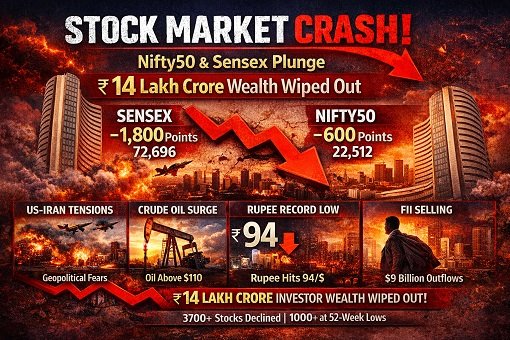
On March 23, 2026, both benchmark indices — Nifty50 and BSE Sensex — closed deep in the red.
- Sensex fell over 1,800 points to around 72,696
- Nifty50 dropped more than 600 points to near 22,512
- Overall market capitalization dropped sharply, wiping out ₹14 lakh crore in investor wealth
This kind of fall is not routine. It signals strong fear among investors, not just normal profit booking.
Even more concerning, mid-cap and small-cap stocks fell even harder — nearly 4% down, showing that selling pressure was everywhere, not limited to big companies.
Why Did the Stock Market Crash Today?
There wasn’t just one reason. This crash was triggered by a mix of global and domestic factors coming together at the same time.
1. Rising Global Tensions (US-Iran Conflict)
The biggest trigger came from geopolitical tensions in the Middle East.
The ongoing conflict involving the US, Iran, and Israel has created serious uncertainty in global markets. Investors fear disruptions in oil supply and possible escalation into a larger conflict.
When war risks rise, stock markets usually fall — and that’s exactly what happened.
2. Crude Oil Prices Crossing $110
India depends heavily on imported oil. So when crude prices shoot up, it directly affects the economy.
- Oil prices crossed $110 per barrel
- Prices have surged over 50% in recent weeks
Higher oil prices mean:
- Rising inflation
- Increased cost for businesses
- Lower corporate profits
This makes investors nervous, leading to selling.
3. Rupee Hits Record Low
The Indian rupee weakened sharply and touched a record low near 94 per dollar.
A falling currency is bad news because:
- Imports become expensive
- Inflation rises further
- Foreign investors lose confidence
This added more pressure on the market.
4. Massive Foreign Investor Selling (FII Outflow)
Foreign investors have been pulling money out of Indian markets continuously.
- Nearly $9–10 billion withdrawn in March alone
When big global funds exit, markets fall fast. That’s exactly what happened today.
5. Weak Global Markets
The crash wasn’t just in India. Markets across Asia, Europe, and the US also fell.
- Japan and South Korea markets dropped sharply
- US markets ended lower last week
When global markets fall together, Indian markets rarely stay stable.
6. Rising US Bond Yields
US bond yields have been increasing, making them more attractive for investors.
This causes:
- Money shifting from stocks to safer bonds
- Reduced liquidity in equity markets
This indirectly contributed to today’s sell-off.
7. Sector-Specific Triggers and Panic Selling
Some additional triggers made things worse:
- Banking stocks fell sharply
- Metals and financial stocks saw heavy losses
- News like sudden leadership changes in major companies added uncertainty
Once panic starts, it spreads quickly — and that’s what turned a decline into a crash.
How Severe Was the Damage?
This wasn’t just about index numbers.
- Over 3,700 stocks declinedin a single day
- Nearly 1,000 stocks hit 52-week lows
- Almost all sectors ended in red
This shows the fall was broad-based, not limited to a few companies.
Also, both Sensex and Nifty are now close to 1-year lows, and markets have already corrected significantly in 2026 so far.
Is This a Short-Term Panic or a Bigger Warning?
Right now, it looks like a mix of both.
Short-Term Factors
- War-related fears
- Oil price spikes
- Global market reaction
These can reverse if the situation stabilizes.
Long-Term Concerns
- Continuous FII outflows
- Weak rupee
- Inflation pressure
These are deeper issues and may keep markets volatile for some time.
What Should Investors Do Now?
This is the question everyone is asking.
1. Avoid Panic Selling
Crashes often push people to sell at the worst time. That usually locks in losses.
2. Focus on Long-Term Investing
Markets go through cycles. Corrections are part of the journey.
3. Watch Global Developments
Right now, global events are driving the market more than domestic factors.
4. Stay Cautious with High-Risk Stocks
Small-cap and mid-cap stocks are falling faster. Risk is higher there.
Final Thoughts
Today’s stock market crash was not random. It was the result of rising global tensions, expensive oil, a weak rupee, and heavy foreign selling — all hitting at once.
₹14 lakh crore wiped out in a single day is a reminder of how quickly markets can change.
But history also shows something important — markets recover, sometimes faster than expected.
For now, the mood is cautious. The next move will depend largely on what happens globally, especially in the Middle East.
One thing is clear — this is a phase investors will remember for a long time.

Satyakam is a seasoned professional content writer with over 15 years of experience in creating high-quality, research-driven content for digital platforms. He specialises in business, finance, banking, law, technology, and informational blogs.