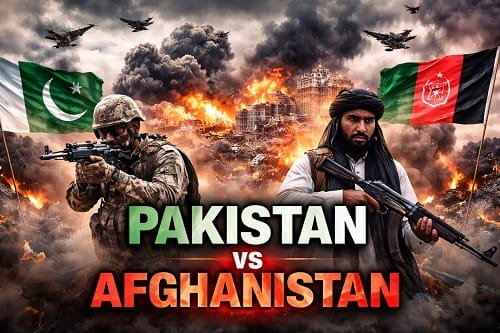
Late February 2026 saw one of the most dramatic escalations in relations between Pakistan and Afghanistan in years — with airstrikes, ground clashes, and even official declarations of open war replacing months of simmering hostility. What began as cross-border skirmishes has quickly grown into a serious military confrontation, threatening security across South Asia.
On February 26–27, Pakistan launched a series of airstrikes inside Afghan territory, hitting major cities including Kabul, Kandahar, and Paktia and targeting installations it blamed on the Islamic Emirate of Afghanistan (the Taliban government) and allied militant groups. Islamabad has called this offensive Operation Ghazab Lil Haq — translated as “the wrath for truth” — and insists its forces are responding to repeated attacks on Pakistani soil.
Tit-for-Tat Violence Along the Durand Line
The current crisis didn’t erupt overnight. For months, border clashes, mutual accusations, and low-level fighting have slowly eroded whatever fragile restraint existed between the two neighbours. Pakistan repeatedly claimed that Tehreek-e-Taliban Pakistan (TTP) fighters and allied militants were using Afghan territory as a safe haven to launch attacks in Pakistan. Afghan authorities denied these charges.
Tensions intensified after a series of suicide bombings and militant assaults within Pakistan earlier this month, including one that killed worshippers in Islamabad. The Pakistani military responded with airstrikes on alleged militant hideouts in eastern Afghanistan’s Nangarhar and Paktika provinces on February 21–22, declaring them precise, intelligence-led strikes against extremist camps.
Afghan officials, however, condemned those strikes as unlawful violations of sovereignty and said they hit civilian homes and religious sites. Taliban authorities reported civilian casualties, including women and children, and vowed to answer in due course.
Afghanistan’s Counter-Attacks and Escalation
Late on February 26, Afghanistan’s military forces crossed into Pakistani territory, attacking border posts. The Taliban government claimed it captured Pakistani positions and inflicted significant casualties — asserting it was retaliating for earlier Pakistani air raids. Islamabad rejected these claims and condemned the offensive as unprovoked aggression.
This exchange set the stage for Pakistan’s broad air campaign the next morning. Jets struck targets in Kabul and other cities, with security sources saying the operations focused on Taliban military headquarters, ammunition dumps, and other strategic positions. Pakistan framed the campaign as necessary to protect its citizens and territory from ongoing militant threats.
Just hours later, Pakistan’s Defence Minister Khawaja Asif publicly declared that Islamabad and Kabul were now in a state of open war — the first such declaration in decades between these two neighbours. The statement marked a dramatic shift from diplomatic tensions to overt military confrontation.
Conflicting Casualty Figures and the Fog of War
One of the stark features of this conflict has been the conflicting casualty reports from both sides.
Pakistan’s military sources claimed that more than 130 Taliban fighters were killed and several militant posts destroyed during the most recent strikes. Taliban accounts, however, said that around 55 Pakistani soldiers were killed in the cross-border attacks and that Afghan forces suffered minimal losses. These sharply diverging figures underscore how difficult it is to verify events amid active combat.
There are also early reports of civilian harm on both sides, including injuries near the heavily militarised Torkham border crossing and displacement of local residents. United Nations officials and rights groups have urged both governments to limit harm to non-combatants and respect international law — calls that so far have had limited impact on the ground.
Historical Context: A Border Always Borne of Tension
The Durand Line, the 2,600-kilometre border between Afghanistan and Pakistan, has been a persistent flashpoint since it was drawn in 1893. Kabul has historically refused to formally recognise it, and militant groups have long used the rugged terrain on both sides to evade security forces.
Past clashes in 2025 and earlier have repeatedly flared into violence, often sparked by militant attacks and followed by punitive campaigns. Qatar and other regional actors mediated a ceasefire in late 2025, but that arrangement appears to have collapsed amid mutual distrust and renewed hostilities this year.
What Happens Next?
As of now, there is no clear end in sight. Pakistan appears determined to sustain its military offensive until it believes the Taliban government takes firmer action against militants allegedly operating within Afghan territory. Kabul, for its part, insists Pakistan’s strikes are unjustified violations of sovereignty and pledges to defend its borders.
Diplomatic channels remain strained, and international efforts to broker peace have not yet produced visible progress. With both nations on a war footing, even a minor incident could escalate further, drawing in regional powers and complicating an already tense geopolitical landscape.
In a region long marked by mistrust and conflict, this latest confrontation could define security dynamics for months — or even years — to come.

Satyakam is a seasoned professional content writer with over 15 years of experience in creating high-quality, research-driven content for digital platforms. He specialises in business, finance, banking, law, technology, and informational blogs.