The iPhone Air is no longer a rumor, a concept, or a fan-made idea. It is a real product, officially launched by Apple on September 9, 2025, as part of the iPhone 17 lineup. With this launch, Apple quietly retired the “Plus” model and introduced something very different—an iPhone built around thinness, balance, and everyday comfort.
In 2026, the iPhone Air stands as Apple’s most radical design shift in years. Not because it is the most powerful iPhone, but because it dares to prioritize form and feel over hardware excess.
A New Position in the iPhone Lineup
Apple placed the iPhone Air squarely between the standard and Pro models. The lineup now looks like this:
● iPhone 17
● iPhone Air
● iPhone 17 Pro
● iPhone 17 Pro Max
The Air is designed for users who want a premium experience without the bulk and visual complexity of multi-camera Pro devices.
Design: The Thinnest iPhone Ever Made
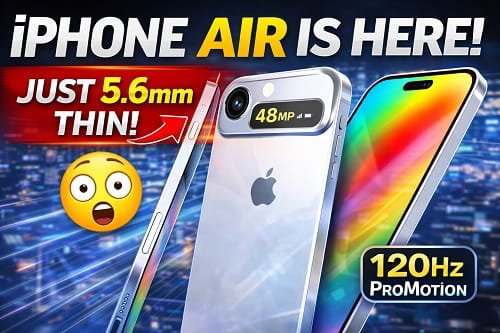
The defining feature of the iPhone Air is its astonishing thinness.
● Thickness: just 5.6mm
● Thinner than the iPhone 6 (6.9mm)
● The thinnest iPhone Apple has ever shipped
To achieve this, Apple introduced a completely new rear design called the camera plateau. Instead of a traditional raised camera bump, a horizontal bar runs across the back of the phone. This structure houses the camera module and helps distribute internal components like the battery and chips.
An unexpected benefit: the phone does not wobble on a desk, something even thicker iPhones struggle with.
The frame is made from high-gloss titanium, giving the device strength without adding weight. In hand, the iPhone Air feels almost unreal—light, flat, and effortless to hold.
Display: No Compromises Anymore
Unlike previous “non-Pro” iPhones, the Air does not cut corners on display technology.
● 6.5-inch Super Retina XDR OLED
● 120Hz ProMotion
● Always-On Display
● Excellent brightness and color accuracy
In 2025, Apple finally standardized ProMotion across the entire lineup, and the iPhone Air benefits fully. Scrolling feels fluid, animations are smooth, and the screen quality matches Pro expectations.
Performance: Pro-Level Where It Matters
Despite its thin body, the iPhone Air runs on a powerful chip:
● A19 Pro processor
● Slightly binned version with 5 GPU cores
● 12GB RAM
The increased RAM is critical for Apple’s on-device AI features under Apple Intelligence. In real-world use—apps, multitasking, gaming, and media—the Air performs extremely close to the Pro models.
This is not a “light” phone in performance terms. It simply avoids unnecessary excess.
Camera: One Lens, Strong Software
To maintain the 5.6mm profile, Apple made a controversial but deliberate choice.
● Single 48MP Fusion rear camera
● No ultra-wide lens
● No telephoto lens
Apple relies heavily on computational photography, sensor cropping, and software zoom. For most everyday photography, results remain excellent, though Pro users will miss optical zoom options.
The front camera, however, received a major upgrade:
● 24MP selfie camera
● New Center Stage support
● Works even in portrait orientation
For video calls, creators, and social content, the front camera is one of the strongest features of the iPhone Air.
Connectivity Shift: eSIM Only, Everywhere
The iPhone Air marks another Apple first:
● No physical SIM tray
● eSIM-only worldwide
Unlike earlier models where this was limited to the U.S., the Air made eSIM mandatory globally. This signals where Apple is heading long-term with iPhone design.
Battery and Daily Use
Battery capacity is smaller due to the ultra-thin design, but Apple offsets this with:
● Highly efficient A19 Pro chip
● OLED display optimizations
● Software-level power management
For most users, the iPhone Air comfortably lasts a full day with normal use. It is not a battery champion, but it is reliable.
Price and Target Audience
● Starting price: $999
● Positioned between iPhone 17 and iPhone 17 Pro
The Air is aimed at users who:
● Want a premium iPhone
● Care about comfort and weight
● Prefer clean design over camera quantity
● Use their phone constantly throughout the day
Final Verdict
The iPhone Air represents a quiet shift in Apple’s priorities. Instead of chasing bigger camera arrays and thicker designs, Apple asked a simpler question: What makes an iPhone enjoyable to live with?
The answer is thinness, balance, and restraint.
In 2026, the iPhone Air is not the most extreme iPhone—but for many users, it may be the most thoughtful one Apple has made in years.

Satyakam is a seasoned professional content writer with over 15 years of experience in creating high-quality, research-driven content for digital platforms. He specialises in business, finance, banking, law, technology, and informational blogs.