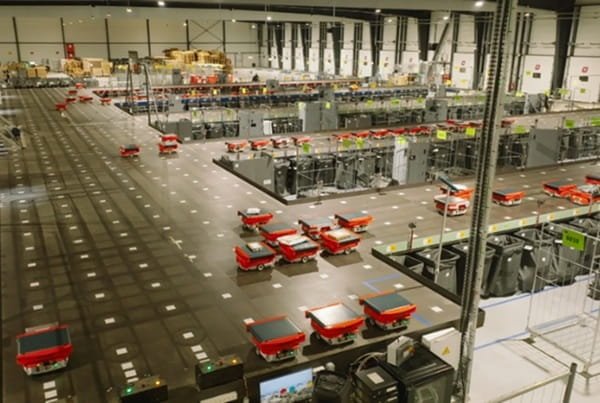
Warehouses operating around continuous order fulfilment cannot treat automation implementation as a project that interrupts daily operations for long periods. Fixed automation can require substantial changes to warehouse layouts, infrastructure, and workflows, creating challenges for facilities maintaining throughput during upgrades. Mobile robots offer a different path by bringing robotic movement directly into existing workflows without requiring the entire facility to be redesigned.
An automated material handling system based on mobile robotics can therefore become a modular layer that develops alongside existing warehouse activity. Technological advances are also strengthening the case for AMR adoption. Sensor fusion using LIDAR, vision cameras, and SLAM is achieving commercial adoption, while sensor-fusion AMRs are expected to exhibit 70% growth rates. This makes flexible robotic movement relevant where downtime is difficult.
The Limits of Fixed Automation in Always-Operating Warehouses
Large-scale infrastructure changes can disrupt established material flows, storage arrangements, and fulfilment processes when warehouses cannot pause operations. Fixed systems can create greater dependency on predefined layouts and dedicated automation infrastructure, making operational changes more disruptive when order profiles or storage requirements evolve.
The challenge is therefore introducing an automated material handling system without compromising continuity across existing warehouse activity. Facilities that need to maintain order processing while changing their operating model require an approach that can be introduced progressively rather than through one extensive implementation phase.
Mobile Robots as a Flexible Layer Within Existing Warehouse Operations
Mobile robots can move through existing warehouse environments and introduce an automated material handling system without requiring every process to be redesigned around permanent equipment. According to Business Research Insights, Industrial facilities implementing AMRs recorded 42% lower manual transport dependency and 31% faster inventory movement efficiency. This flexibility allows warehouses to introduce automation around specific workflows while keeping other processes operational.
- Targeted deployment: Robotic movement can be introduced where manual transportation creates the greatest operational constraint.
- Existing workflows: Automation can become part of the warehouse’s operating model without requiring every process to change simultaneously.
- Flexible expansion: Additional robotic activity can be introduced as operational requirements develop.
This creates a practical entry point for broader automation because warehouses can address specific movement challenges first while retaining existing storage, picking, and fulfilment infrastructure where effective.
Scaling Automation Without Rebuilding the Warehouse
Modular mobile robotics allows automation capacity to evolve alongside warehouse automation as order volumes, workflows, and warehouse requirements change. Additional robotic capacity can address changing operational requirements without major fixed infrastructure changes, giving facilities greater flexibility as activity develops. This model is useful when requirements change, and automation capacity needs to grow without lengthy implementation interruptions today.
| Operational requirement | Modular mobile robotics approach | Benefit for active warehouses |
| Changing order volumes | Add robotic capacity progressively | Automation can evolve with demand |
| Manual transport constraints | Target specific movement workflows | Focuses automation where constraints occur |
| Existing infrastructure | Work around established layouts | Reduces dependence on major reconstruction |
| Expanding automation | Introduce additional robotic processes | Allows capability to develop progressively |
This approach lets warehouses automate individual material-movement processes while retaining existing infrastructure where effective. For facilities protecting ongoing operations, the ability to expand automation without rebuilding the warehouse can make modular deployment a practical part of longer-term planning.
Maintaining Operational Continuity During Automation Expansion
According to Business Research Insights, facilities utilising AMRs experience 27% lower operational downtime and up to 36% higher overall productivity compared with traditional manual environments. Automation projects in active warehouses need to account for uninterrupted order processing, material availability, workforce movement, and existing fulfilment commitments.
The Mobile robots can operate alongside established warehouse processes, allowing automation to be introduced without making the entire facility dependent on a single implementation phase. Operational teams can adapt workflows progressively as robotic systems become part of daily warehouse activity:
- Order processing: Existing fulfilment commitments can continue while robotic movement is introduced progressively.
- Material availability: Automated movement can be incorporated without making the entire operation dependent on one implementation phase.
- Workforce movement: Established warehouse activity can remain part of the operating model as robotic processes develop.
This creates an automation strategy built around continuity, adaptability, and controlled operational change rather than extended facility shutdowns.
Building a Modular Automation Strategy with Addverb’s Mobile Robotics
Addverb’s mobile robotics solutions enable automated material movement within warehouse environments where operations need to continue while automation is introduced. Rather than requiring movement processes to be redesigned around permanent equipment, mobile robots can be deployed around specific transportation requirements, allowing facilities to automate selected workflows while retaining existing storage, picking, and fulfilment arrangements.
Addverb’s AMR, Dynamo, is designed for this kind of flexible material movement, carrying payloads of up to 2,500 kg at speeds of up to 0.8 m/s. Its autonomous navigation allows it to move materials through warehouse environments without fixed tracks, making it suitable for operations where movement requirements can change, and automation needs to work around existing activity.
Conclusion
Warehouses that cannot afford prolonged downtime need automation strategies that fit around ongoing operations rather than forcing operations to fit around a major infrastructure change. Mobile robotics provides a flexible foundation for introducing, expanding, and adapting automation while preserving continuity across warehouse workflows.
For facilities pursuing long-term automation without sacrificing operational flexibility, modular mobile robotics offers a pathway towards a more adaptable warehouse environment. Addverb’s mobile robotics approach can help create automated movement around specific requirements while allowing the broader automation environment to evolve progressively as warehouse operations change.

Santosh Kumar is a Professional SEO and Blogger, With the help of this blog he is trying to share top 10 lists, facts, entertainment news from India and all around the world.