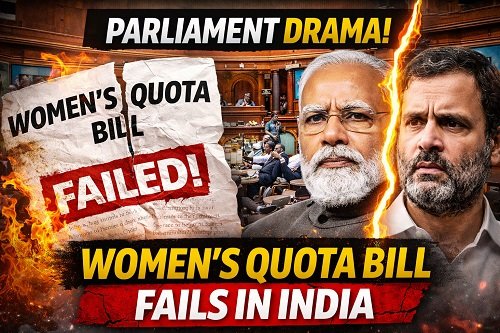
The Indian Parliament recently witnessed one of its most intense debates in years over the Women’s Reservation Bill. What looked like a historic step for women’s political empowerment quickly turned into a political battle—and in the end, the bill failed to pass.
Here’s the complete, clear breakdown of what actually happened, based on the latest updates.
What is the Women’s Reservation Bill?
The Women’s Reservation Bill aims to reserve 33% of seats for women in:
- Lok Sabha
- State Legislative Assemblies
This idea has been discussed in India for nearly three decades, mainly because women remain underrepresented in politics. Currently, women make up only around 14–15% of Lok Sabha members.
The bill was finally passed in 2023 as the Nari Shakti Vandan Adhiniyam, but its implementation was delayed until after:
- A fresh census
- Delimitation (redrawing constituencies)
What Happened in Parliament in April 2026?
In April 2026, the government introduced a new constitutional amendment—called the Constitution (131st Amendment) Bill, 2026—to fast-track the implementation of women’s reservation.
This amendment was linked with:
- Expanding Lok Sabha seats (from 543 to ~850)
- Redrawing constituency boundaries (delimitation)
After two days of heated debate, voting took place in Lok Sabha.
Voting Result:
- Around 298 MPs voted in favour
- Around 230 MPs voted against
However, a constitutional amendment needs a two-thirds majority, and the bill fell short of that requirement, leading to its rejection.
Why Did the Bill Fail?
Interestingly, most parties supported women’s reservation in principle. The real conflict was about how it was being implemented.
1. Link with Delimitation
The biggest issue was that the bill was tied to delimitation.
Delimitation means:
- Redrawing constituencies
- Increasing total seats in Parliament
Opposition parties feared this would:
- Increase representation of northern states(higher population)
- Reduce influence of southern states
They argued this could shift political power unfairly.
2. Demand for Census First
Many leaders said delimitation should happen only after a proper census.
Since India has not conducted a recent census, critics claimed:
- The data would be outdated
- Seat distribution may become biased
3. Political Strategy Concerns
Some opposition leaders openly called the move a political strategy rather than a genuine reform.
They argued:
- The government was trying to reshape electoral boundaries
- The timing was politically motivated
At the same time, the government accused the opposition of blocking a historic opportunity for women.
What Happened After the Bill Was Rejected?
The rejection triggered:
- Loud protests inside Parliament
- Political blame game between ruling party and opposition
- Suspension of related reforms
Most importantly:
👉 The Delimitation Bill 2026 was also shelved after the failure of this amendment.
Important Update: The 2023 Law is Still Active
Here’s a key point many people misunderstand.
The Women’s Reservation law passed in 2023 is already in force.
In April 2026, the government officially notified it, meaning:
- The law exists
- But implementation is still pending
It is expected to be लागू from 2029 elections, after:
- Census
- Delimitation
Why This Issue Matters
This is not just about one bill. It’s about the future of Indian politics.
If implemented:
- One-third of MPs will be women
- Policy-making could become more inclusive
- Gender representation gap may reduce significantly
But the current situation shows a deeper issue:
👉 Consensus is still missing in Indian politics, even on widely supported reforms.
Political Reactions
The reactions after the vote were sharp and divided:
- Government leaders said opposition “betrayed women”
- Opposition leaders said they “saved democracy”
Even within Parliament:
- Protests were held
- Strong statements were made on both sides
- The atmosphere turned highly charged
Final Understanding
The Women’s Reservation Bill did not fail because people oppose women’s representation.
It failed because:
- It was linked with delimitation
- Political trust was low
- Consensus was missing
At the same time, the bigger picture remains:
👉 Women’s reservation is coming—but not immediately
India may finally see it implemented around 2029, if all conditions are met.

Satyakam is a seasoned professional content writer with over 15 years of experience in creating high-quality, research-driven content for digital platforms. He specialises in business, finance, banking, law, technology, and informational blogs.