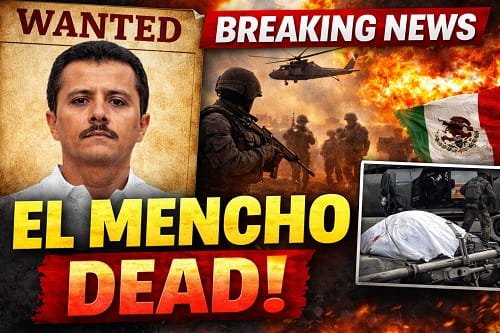
After years of being one of the most elusive and wanted criminals in the world, Nemesio Oseguera Cervantes, better known as El Mencho, has been killed in a high-stakes military operation in Mexico. His death marks a dramatic turning point in Mexico’s long fight against cartel violence — and has already triggered waves of unrest across the country.
Who Was El Mencho?
El Mencho was the head of the Jalisco New Generation Cartel (CJNG), one of the most powerful and violent drug trafficking organisations in Mexico and abroad. Born in 1966 in Michoacán, Mexico, Oseguera rose through the criminal ranks over decades, building CJNG into a sprawling syndicate known for brutal tactics, heavy weaponry, and extensive drug distribution networks.
Under his leadership, CJNG was linked to trafficking fentanyl, methamphetamine, cocaine, and heroin into markets across the United States and beyond. U.S. and Mexican authorities had placed a bounty of up to $15 million on information leading to his capture — one of the highest rewards ever offered for a cartel leader.
How and When Did He Die?
On 22 February 2026, Mexican Army forces launched a coordinated security operation in Tapalpa, in the western state of Jalisco, which intelligence reports said was a confirmed location of El Mencho. The mission involved the Mexican Army, National Guard, Air Force, and federal law enforcement, with complementary intelligence support from the United States.
During the raid, troops encountered fierce resistance from cartel gunmen. El Mencho was wounded in the firefight and evacuated by helicopter. However, he died from his injuries while being transported to a medical facility in Mexico City. Multiple other cartel members were also killed in the clash, and several suspects were arrested.
Immediate Aftermath: Violence and Chaos
The news of El Mencho’s death spread quickly — and so did violence.
CJNG affiliates and other armed factions responded with a coordinated campaign of retaliation across several Mexican states. Highways were blocked with burning vehicles, businesses and vehicles were set on fire, and clashes erupted between cartel members and security forces. Authorities reported casualties on both sides, and residents were urged to shelter in place in affected areas.
International travel was disrupted too: several aircraft carriers, including Air Canada and United Airlines, suspended flights to key Mexican states like Jalisco and Colima amid safety concerns.
The Indian Embassy also issued safety advisories, urging Indian nationals in Mexico to remain in secure locations while the situation stabilised.
Why This Matters: A Major Blow to Organized Crime
El Mencho’s death is arguably one of the most significant wins for Mexican security forces in decades.
CJNG had grown rapidly in recent years, challenging rival cartels like the Sinaloa Cartel for territory and influence. Its use of military-grade weapons, drones, and coordinated attacks — including a 2015 incident where cartel members allegedly shot down a Mexican Army helicopter to protect El Mencho — made it one of the most formidable criminal organisations in Mexico’s ongoing drug war.
Taking out its founder and leader cuts off the head of the organisation’s leadership, interrupting operations and causing internal instability.
Still, cartel experts warn that eliminating a kingpin rarely ends violence altogether. Groups often fracture, splinter factions emerge, and battles for succession can lead to fresh bursts of bloodshed.
Who Might Lead CJNG Now?
With El Mencho gone, the future leadership of CJNG is uncertain. Historically, cartels with strong organisational layers have handed power to trusted lieutenants, family members, or rival commanders following the death or capture of a boss.
Analysts believe several scenarios are possible:
● A power struggle within CJNG’s top hierarchy
● A coalition leadership model where senior commanders share control
● A takeover by a competing criminal group or allied faction
Only time will tell whether CJNG survives as a unified force or fractures into multiple rival factions.
Global and Regional Reactions
International responses were swift. The U.S. government praised the operation as a significant achievement in combating transnational drug trafficking, and expressed continued support for Mexico’s anti-cartel efforts.
Travel advisories and diplomatic communications quickly followed, not just from India, but also from Canada and European governments, as unrest continued in several Mexican states.
What This Means for Mexico’s Drug War
El Mencho’s death is a symbolic and strategic moment in the long and violent conflict between the Mexican state and powerful drug cartels. It represents a major tactical victory for security forces. But it does not mean the end of violence — far from it.
Cartel networks often adapt when leaders fall, and a period of turbulence can sometimes lead to spikes in violence as rival factions jockey for dominance.
In cities and states historically affected by CJNG activities, the coming months will be critical to watch. Government responses, community impact, and cartel dynamics will shape Mexico’s security landscape for years to come.
Final Takeaway
This moment closes a chapter in Mexico’s battle against powerful cartels—but it doesn’t end the wider conflict. The real test now lies in what happens next: how CJNG responds, how authorities manage the fallout, and whether there is a lasting impact on organised crime in Mexico.

Satyakam is a seasoned professional content writer with over 15 years of experience in creating high-quality, research-driven content for digital platforms. He specialises in business, finance, banking, law, technology, and informational blogs.