
Laboratory glassware is a vital component in research and industrial processes, where accuracy, chemical resistance, and strength determine efficiency. Round bottom flasks and flat-bottom flasks are among the necessary glassware, each with a specific purpose that affects experimental precision, heat transfer, and sample handling. The selection between the two is based on heating techniques, storage needs, and types of reactions.
Structural Design and Material Composition
Laboratory flasks must meet strict material standards for thermal stability, chemical resistance, and mechanical durability. Both round bottom and flat bottom flasks are typically manufactured using 3.3 low-expansion borosilicate glass, offering resistance to extreme temperatures and corrosive substances.
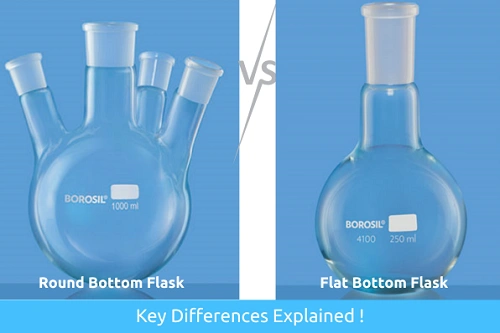
Comparison of Flask Structures
| Feature | Round Bottom Flask | Flat Bottom Flask |
| Base Shape | Spherical | Flat |
| Heating Efficiency | High, uniform heating | Moderate, works on hotplates |
| Stability | Requires stand or clamp | Self-supporting |
| Vacuum Suitability | Ideal for reduced-pressure applications | Less suitable for vacuum use |
| Storage Capability | Not ideal for long-term storage | Stands independently, suited for storage |
| Typical Use Cases | Distillation, reflux, extractions | Sample prep, chemical storage, simple heating |
Round Bottom Flasks: Features and Applications
A round bottom flask is designed for distillation, reflux reactions, and solvent extraction where uniform heating is critical. The spherical shape eliminates sharp angles, providing even heat distribution, minimising hot spots, and reducing the risk of thermal stress fractures.
Key Features of a Round Bottom Flask
- Uniform Wall Thickness: Ensures consistent heating and prevents breakage under vacuum.
- Interchangeable Joint Compatibility: Connects seamlessly with condensers, reflux columns, and distillation setups.
- Reduced Sample Residue: No corners for material buildup, improving recovery rates.
- Vacuum Resistant: This can withstand reduced pressure, making it suitable for vacuum filtration and rotary evaporation.
Multineck Round Bottom Flasks
For complex synthesis or distillation reactions requiring multiple reagent additions or gas inlets, multi-neck round bottom flasks are preferred. These flasks, available with 2-4 necks, facilitate simultaneous reagent introduction, temperature monitoring, and vapour refluxing.
Common Applications of Multineck Flasks:
| Application | Why Multineck Flasks are Used? |
| Fractional Distillation | Separate components based on boiling points with controlled reflux. |
| Reflux Reactions | Allows simultaneous heating and cooling for continuous reactions. |
| Parallel Reagent Addition | Multiple necks enable controlled addition of different reagents. |
| Inert Atmosphere Reactions | Side necks facilitate argon/nitrogen purging for air-sensitive compounds. |
Flat Bottom Flasks: Features and Applications
A flat-bottom flask is primarily used for sample storage, reagent preparation, and simple heating applications. The flat base allows direct placement on benchtops and hotplates, reducing the need for additional support structures.
Key Features of a Flat Bottom Flask
- Self-Supporting Design: Can be placed on a flat surface without clamps or stands.
- Moderate Heating Compatibility: Works with hotplates and water baths, though heat distribution is less uniform than round bottom flasks.
- Increased Stability for Storage: Ideal for buffer solutions, chemical reagents, and sample holding.
- Lower Risk of Accidental Spillage: More stable than round bottom flasks when handling volatile or hazardous chemicals.
Common Uses of Flat Bottom Flasks
| Application | Why Flat Bottom Flasks are Used? |
| Chemical Storage | Provides upright positioning for long-term stability. |
| Reagent Mixing | Ideal for buffer solutions, titration setups, and stock solutions. |
| Heating on Hotplates | Suitable for low-to-moderate temperature heating applications. |
| General Sample Handling | Convenient for temporary sample storage and preparation. |
Round Bottom Flask vs. Flat Bottom Flask: Choosing the Right Flask
The choice between a round-bottom flask and a flat-bottom flask depends on the specific experimental setup and the level of thermal precision required.
| Requirement | Best Flask Choice | Reason |
| Uniform Heating | Round Bottom Flask | Ensures even heat distribution during distillation, reflux, or extractions. |
| Vacuum Compatibility | Round Bottom Flask | Withstands reduced pressure without collapsing. |
| Hotplate Heating | Flat Bottom Flask | Can be placed directly on heating plates without support. |
| Chemical Storage | Flat Bottom Flask | Stable for long-term reagent storage. |
| Complex Reactions | Multineck Round Bottom Flask | Facilitates simultaneous reagent addition and reflux control. |
Handling and Maintenance Best Practices
Cleaning and Storage Guidelines
- Cleaning: Use appropriate solvent rinses (e.g., acetone for organic residues, dilute acid for inorganic deposits).
- Storage: Round bottom flasks should be stored in racks, while flat bottom flasks can stand upright in cabinets.
- Avoid Thermal Shock: Never expose borosilicate glass flasks to sudden temperature changes, as this may lead to stress fractures.
Heating Considerations
| Flask Type | Recommended Heating Method |
| Round Bottom Flask | Use heating mantles, oil baths, or Bunsen burners for uniform heating. |
| Flat Bottom Flask | Place directly on a hotplate or water bath for gentle heating. |
Handling Precautions
- Always use clamps to secure round bottom flasks in place.
- Avoid direct open flame heating with flat bottom flasks.
- Use ground glass stoppers or PTFE sealing rings for airtight closure in sensitive reactions.
Conclusion
Both round bottom flasks and flat bottom flasks serve specific roles in laboratory environments. Round bottom flasks, particularly in multineck configurations, are indispensable for distillation, reflux, and vacuum applications, while flat bottom flasks excel in chemical storage, sample preparation, and simple heating setups.
Laboratories must select the appropriate flask type based on heating method, chemical compatibility, and reaction complexity. Multineck flasks, with their additional entry points for reagent addition and refluxing, further enhance reaction control in complex synthesis and analytical applications.
By choosing the correct glassware, researchers ensure optimal efficiency, reproducibility, and safety, reinforcing the importance of precision-engineered borosilicate glass solutions in modern laboratory workflows.

Santosh Kumar is a Professional SEO and Blogger, With the help of this blog he is trying to share top 10 lists, facts, entertainment news from India and all around the world.