Over the last few weeks, global geopolitics has taken a sharp turn. Scroll through YouTube, watch prime-time debates, or read strategic commentary, and one comparison keeps surfacing again and again: Venezuela and Taiwan. The recent U.S. military operation in Venezuela has triggered a wave of speculation — not just about Latin America, but about Asia’s most dangerous flashpoint. Commentators are asking whether this moment represents a deeper shift in how great powers use force, and more importantly, whether China could point to Venezuela as a precedent to justify stronger action against Taiwan.
This is not an idle or sensational question. Precedents matter in international politics, especially when major powers stretch or reinterpret norms. What has unsettled diplomats and strategists is not only what the United States did in Venezuela, but how it justified the action — framing a military operation as a law-enforcement exercise against a sitting head of state. That framing has unsettled capitals far beyond Caracas. In Beijing, it has triggered a carefully calibrated response that blends condemnation, legal argument, and strategic messaging.
To understand whether Venezuela changes anything for Taiwan, we must step away from headlines and examine how China thinks, how it frames legality, how deterrence actually works, and what constraints still exist. The answer is more complex — and more revealing — than a simple yes or no.
The Venezuela Operation and Why It Shook the System
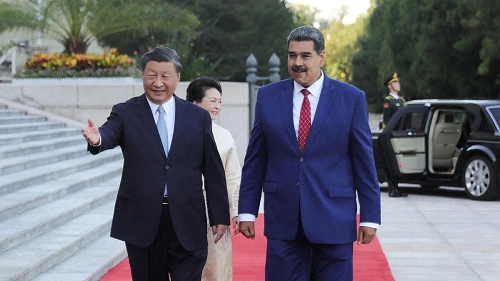
In early January 2026, the United States carried out Operation Absolute Resolve, a swift and highly coordinated military operation inside Venezuela. U.S. special forces, backed by extensive air and cyber support, captured Venezuelan leader Nicolás Maduro and transported him to the United States to face long-standing criminal charges. Washington insisted this was a law-enforcement action, not a war, and framed it as the execution of domestic indictments against an individual accused of narco-terrorism.
For many governments, this distinction felt artificial. A foreign military entering a sovereign country, bypassing its institutions, and extracting its leader crossed a psychological and political line. Even states that have little sympathy for the Venezuelan regime expressed concern about the precedent: if powerful states can redefine military force as law enforcement, where do the limits lie?
This is where Taiwan enters the discussion.
China’s Immediate Response: Condemnation With a Purpose
China’s reaction was fast, sharp, and legally precise. At the United Nations, Beijing condemned the U.S. action as a violation of sovereign equality, accusing Washington of acting as “judge, jury, and enforcer” in the international system. But this was not just moral outrage. It was strategic positioning.
China did not argue that the U.S. had acted against an unfriendly government. Instead, it argued that the U.S. had destroyed sovereignty itself. This distinction matters deeply for Beijing’s Taiwan strategy.
China’s long-standing position is that Taiwan is an internal affair, not a sovereign foreign state. By attacking the U.S. for violating Venezuela’s sovereignty, Beijing is constructing a legal contrast:
- What the U.S. did in Venezuela, China says, was an external power dismantling another state’s sovereignty.
- What China claims it would do in Taiwan, by contrast, would be restoring sovereignty, not violating it.
In other words, Beijing is not using Venezuela to justify action on Taiwan. It is using Venezuela to strengthen its legal wall around Taiwan.
The “Decapitation Strike” Lesson China Is Quietly Studying
Beyond diplomacy, military planners in Beijing are paying close attention to how the Venezuela operation unfolded.
Venezuela’s air-defence network relies heavily on Chinese-supplied systems, including long-range surveillance radars. Despite this, U.S. forces penetrated Venezuelan airspace, neutralised defences, and executed a leadership extraction with precision. This has triggered uncomfortable questions within the People’s Liberation Army.
The unspoken lesson is not encouragement — it is caution.
If a relatively limited operation could bypass Chinese-origin systems in Venezuela, then any Chinese assumption about the survivability of command-and-control assets under real conflict conditions must be reassessed. For Taiwan, this cuts both ways. While Beijing studies decapitation scenarios, it is also being reminded that modern warfare favours intelligence dominance, cyber penetration, and precision — not just massed force.
In this sense, Venezuela may actually reinforce Chinese restraint, not accelerate aggression.
Why Taiwan Is Not Venezuela — Strategically or Politically
Despite surface-level comparisons, Taiwan and Venezuela exist in entirely different strategic universes.
1. Taiwan Is a Global Choke Point
Taiwan sits at the heart of the global semiconductor supply chain and the First Island Chain that shapes Indo-Pacific security. Any conflict there would instantly become global — economically, militarily, and politically. Venezuela, by contrast, is regionally significant but globally peripheral.
2. Military Objectives Are Incomparable
The U.S. operation in Venezuela was about extraction — removing a leadership figure and leaving. Taiwan would require territorial control, amphibious landings, sustained occupation, and long-term governance. No decapitation strike can substitute for that reality.
3. Alliance Structures Change the Equation
Taiwan’s security environment is deeply intertwined with the United States, Japan, and regional partners. Even under strategic ambiguity, China cannot assume isolation. Any move on Taiwan risks a wider regional war — something Beijing has consistently tried to avoid.
The Credibility War: Where Venezuela Does Matter
Where the Venezuela operation does matter is in the psychological and narrative domain.
In the days following the operation, mixed signals emerged from Washington about long-term intentions in Venezuela. This inconsistency has become a talking point for Beijing. Chinese messaging to Taiwan’s leadership and population is subtle but persistent:
Can you rely on a partner that acts impulsively, reframes military force overnight, and struggles to articulate long-term plans?
This is not about tanks crossing the Taiwan Strait. It is about confidence erosion. Beijing’s preferred strategy has always been to weaken Taiwan’s belief in external support while strengthening the perception that resistance is futile over time.
Venezuela offers rhetorical ammunition for that campaign.
Will China Actually Escalate Because of Venezuela?
The short, clear answer is no.
China’s Taiwan policy is driven by:
- domestic political timing
- military readiness and risk tolerance
- economic vulnerability
- regional alliance dynamics
None of these variables changed because of Venezuela.
What has changed is the tone of global debate. The line between law enforcement, intervention, and war has blurred. China will exploit that ambiguity diplomatically, but it will not gamble Taiwan’s future on a Latin American precedent.
If anything, the Venezuela episode reinforces a hard truth: great-power actions are judged less by their legal justifications and more by their consequences. Beijing understands that Taiwan would bring consequences on a scale Venezuela never could.
Conclusion: Precedent as Narrative, Not Permission
The Venezuela operation has become a powerful case study in how great powers stretch norms. China will use it — not as permission to act, but as evidence to argue that the current international order is inconsistent, politicised, and dominated by force.
For Taiwan, this means heightened pressure in the information, diplomatic, and psychological domains, not an imminent invasion justified by Venezuela.
In global politics, precedents shape stories before they shape strategies.
Venezuela has given China a story to tell — but Taiwan remains governed by deterrence, cost, and consequence, not comparison.
That reality, for now, remains unchanged.

Santosh Kumar is a Professional SEO and Blogger, With the help of this blog he is trying to share top 10 lists, facts, entertainment news from India and all around the world.