
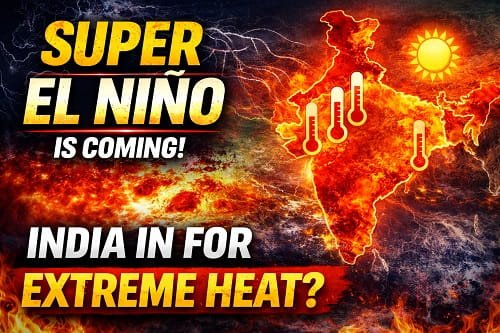
Climate scientists around the world are closely watching the Pacific Ocean as signs of a powerful El Niño event begin to appear. Some experts believe that the developing conditions could evolve into a Super El Niño, a rare and extremely strong climate phenomenon that can reshape weather patterns across the planet.
For countries like India, this could mean higher temperatures, irregular monsoon rainfall, and greater pressure on agriculture and water resources. If the phenomenon strengthens in the coming months, India may experience one of its most challenging climate periods in recent years.
Understanding El Niño
El Niño is a natural climate pattern that occurs when the surface waters of the central and eastern Pacific Ocean become warmer than normal. These temperature changes weaken the trade winds that usually push warm water toward Asia.
As a result, warm ocean water spreads eastward across the Pacific. This shift alters atmospheric circulation and affects weather systems around the globe.
The impacts can vary widely depending on the region. Some parts of the world experience heavy rainfall and floods, while others face droughts, heat waves, and wildfires.
El Niño events generally appear every two to seven years, but their intensity can vary significantly.
What Makes a Super El Niño Different
A Super El Niño is an unusually strong El Niño event in which sea surface temperatures in the Pacific rise far above the normal range.
Scientists measure the strength of El Niño by tracking temperature anomalies in a specific region of the Pacific Ocean. When these anomalies exceed certain thresholds for an extended period, the event is classified as extremely strong.
Historically, only a few El Niño events have reached this level, including:
- 1982–83
- 1997–98
- 2015–16
These events triggered major global climate disruptions. Floods hit parts of South America, droughts affected Southeast Asia, and global temperatures surged.
Because of its potential to influence weather worldwide, a Super El Niño attracts serious attention from meteorologists and climate researchers.
Why India Is Vulnerable
India’s climate is closely tied to the Indian monsoon system, which provides the majority of the country’s annual rainfall. When El Niño develops, it often weakens the monsoon circulation.
A strong or super El Niño can create several challenges for India.
Intense Heat Waves
One of the most immediate effects is rising temperatures. During strong El Niño years, India frequently experiences longer and more intense heat waves.
Temperatures in several states can cross 45°C, particularly in northern and central regions. Urban areas become especially uncomfortable because buildings and roads trap heat.
Hot nights, combined with scorching daytime temperatures, can increase health risks and place heavy demand on electricity systems.
Weak or Unpredictable Monsoon
Another major concern is the monsoon.
When El Niño disrupts atmospheric circulation, the monsoon winds that bring rain to India may weaken. This can result in:
- delayed monsoon onset
- reduced seasonal rainfall
- uneven rainfall distribution
Some regions may face drought-like conditions while others receive sudden bursts of heavy rain.
Such unpredictability makes water management more difficult and increases the risk of crop losses.
Impact on Agriculture
India’s agricultural sector depends heavily on monsoon rainfall. Any disruption in the monsoon cycle can directly affect crop production.
Crops such as rice, pulses, sugarcane, and cotton require steady rainfall during the growing season. If rainfall is insufficient or arrives at the wrong time, yields can decline.
Farmers may also struggle with rising temperatures, which can damage crops and reduce soil moisture.
Lower production often leads to higher food prices, affecting both rural and urban consumers.
Global Climate Effects
The influence of El Niño extends far beyond India.
Strong events can cause major weather disruptions worldwide. South America may experience severe flooding, while countries in Southeast Asia and Australia often face droughts.
El Niño also tends to increase global average temperatures. The strong 2015–16 El Niño contributed to 2016 becoming the hottest year on record at the time.
If a new Super El Niño forms during a period of ongoing global warming, it could push temperatures even higher.
What Scientists Are Monitoring
Meteorologists track several indicators to understand whether El Niño is strengthening.
These include:
- Pacific Ocean surface temperatures
- wind patterns across the equator
- atmospheric pressure differences
- ocean heat content
Data collected from satellites, ocean buoys, and climate models helps scientists forecast how the phenomenon may evolve.
Although forecasts are improving, predicting the exact strength of El Niño remains challenging.
Preparing for the Possible Impact
Governments and climate experts are encouraging better preparation for extreme weather events.
In India, preparations may include:
- improving heat wave warning systems
- managing water resources more efficiently
- supporting climate-resilient agriculture
- strengthening disaster response plans
Urban planning strategies, such as increasing green spaces and reducing heat-trapping infrastructure, can also help reduce the impact of extreme heat.
Conclusion
A Super El Niño does not occur often, but when it does, its effects can be felt across the globe. For India, the biggest risks include severe heat waves, irregular monsoon rainfall, and pressure on agriculture and water supplies.
While scientists continue to monitor ocean temperatures in the Pacific, the coming months will reveal whether the developing conditions grow into a powerful climate event.
If they do, India may need to prepare for a hotter and more unpredictable year ahead.

Satyakam is a seasoned professional content writer with over 15 years of experience in creating high-quality, research-driven content for digital platforms. He specialises in business, finance, banking, law, technology, and informational blogs.