
To start a business in India, it is crucial to choose the right legal structure that suits your needs in terms of liability protection, compliance, funding, and scalability. The most common business forms are Private Limited Company (Pvt Ltd), Limited Liability Partnership (LLP), and One Person Company (OPC). Understanding the key differences can help you decide the best structure, aligning with your business goals and operational style.
Overview
For entrepreneurs unfamiliar with Indian corporate law and aiming to establish their own businesses, seeking the right structure can be both challenging and confusing. The Ministry of Corporate Affairs (MCA) offers several incorporation options, but three stand out for their popularity and practicality: Private Limited Company, Limited Liability Partnership, and One Person Company. Each structure has distinct characteristics that align with specific business models and entrepreneurial goals.
However, among all available options, the private limited company structure is considered to be the backbone of over 200 million successful businesses worldwide, offering the perfect mix of corporate credibility, limited liability protection, and scalable growth potential.
Whether you’re a startup or a seasoned entrepreneur looking to venture with a new business idea, this comprehensive guest post provides a clear roadmap to making an informed decision that helps you take the next step successfully.
What are the Types of Limited Companies in India
Among multiple business structures available in India, three options dominate the global market.
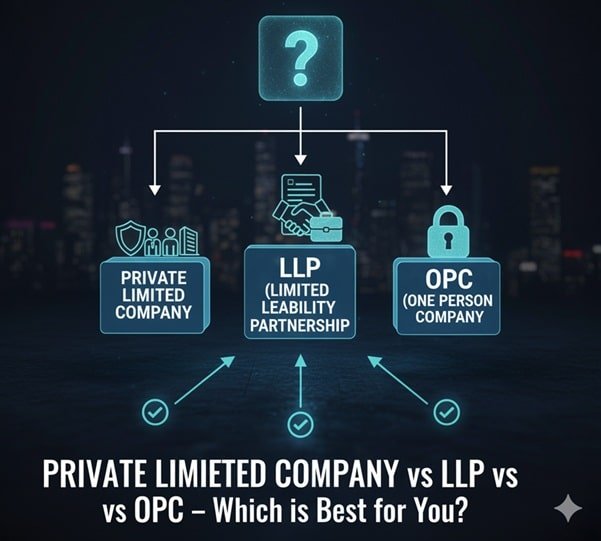
- Private Limited Companies operate under the Companies Act, 2013, requiring at least two directors and shareholders. They provide limited liability and enable equity financing, making them attractive to startups and investors.
- Limited Liability Partnerships (LLPs) combine partnership flexibility and company limited liability protections, requiring at least two partners. They have lower compliance burdens and serve professionals and small businesses well.
- One Person Companies (OPC) allow a single individual to own a company with limited liability, suitable for individual entrepreneurs and professionals who want to separate personal and business liabilities without complexity.

Understanding the Difference between a Pvt.ltd Vs LLP, Vs OPC
Before getting started, it is always recommended to stay informed when choosing between a private Ltd, LLP, and OPC play a pivotal role in your entrepreneurial journey. Here is a clear, well-organized comparison that highlights the crucial factors to help entrepreneurs make informed decisions.
1. Governing Laws and Regulatory Authorities
- Private Limited Companies and OPCs are governed by the Companies Act, 2013
- LLPs operate under the Limited Liability Partnership Act, 2008.
- Governed and controlled under the Companies Act, 2013
All three forms are regulated by the Ministry of Corporate Affairs (MCA), ensuring legal compliance and transparent governance.
2. Ownership and Management
- Private Limited Company: Requires at least two shareholders and two directors. The maximum members can go up to 200, and the number of directors can be up to 15. At least one director must be an Indian resident.
- LLP: Requires a minimum of two designated partners, with no maximum limit, but limits managerial partners as per agreement. One partner must be an Indian resident.
- OPC: Designed for a single person as the sole shareholder and director, with a mandatory nominee for continuity. An OPC can have up to 15 directors.
3. Liability Protection
All three structures provide limited liability protection:
- Shareholders of Pvt Ltd and OPCs have liability limited to their share capital.
- LLP partners’ liability is limited to their capital contribution and does not extend to the actions of other partners, providing additional protection.
4. Compliance Requirements
- Private Limited Company: Has the highest compliance burden, including mandatory statutory audits, regular board meetings, minute maintenance, and annual filings with the Registrar of Companies (RoC).
- LLP: LLPs in India require moderate compliance. Statutory audit under the Companies Act and Income Tax Act is mandatory if the LLP’s annual turnover exceeds ₹40 lakhs or the contribution of partners exceeds ₹25 lakhs.
- OPC: Falls between the two, requiring annual filings and audits similar to Pvt Ltd companies, but without the need to hold board meetings, simplifying management obligations.
Tax Implications
- Private Limited Company: Corporate tax applies at 22% plus applicable surcharges and cess, along with Dividend Distribution Tax (DDT) and Minimum Alternate Tax (MAT).
- LLP: Taxed at a flat 30% corporate tax, but without DDT or MAT, making it tax-efficient for profit distribution. LLPs enjoy pass-through taxation benefits, avoiding double taxation on distributed profits.
- OPC: Taxed similarly to Private Limited Companies, with corporate tax rates around 22% plus applicable charges.
To speed up and streamline the registration process, partnering with experienced legal consultancy agencies like Taxlegit can enable you to complete the entire process in as little as 10 days, provided you have proper document preparation and expert guidance.
A Quick Analysis: Private Limited vs LLP vs OPC
| Feature | Private Limited Company | LLP | OPC |
| Minimum Members | 2 Directors, 2 Shareholders | 2 Partners | 1 Director/Shareholder + 1 Nominee |
| Foreign Ownership | Allowed (FDI permitted) | Allowed with restrictions | Not allowed (only Indian citizens/NRIs) |
| Liability | Limited to share capital | Limited to the contribution | Limited to share capital |
| Fundraising | Easy – equity, VC, PE allowed | Complicated to no equity option | Tough – equity restrictions |
| Taxation | Corporate tax + dividend tax | Pass-through taxation | Corporate tax rates |
| Audit Requirement | Mandatory if turnover >₹1 crore | Only if turnover >₹40 lakh | Mandatory if turnover >₹2 crore |
| Compliance Level | Medium (AGM, board meetings, multiple filings) | Low (mainly annual return) | Medium (lighter than Pvt Ltd) |
| Conversion Flexibility | Can convert to a public company | Can convert into a Private/Publiccompany | Must convert if turnover >₹2 crore |
| Investment Suitability | Excellent for VC/PE | Poor for equity investment | Poor for external funding |
| Best For | Scalable startups, funded businesses | Professional services, partnerships | Solo entrepreneurs, small businesses |
Which Company Structure is the Right Structure for You?
Setting up the right business structure is a crucial step for your business growth in India, as it impacts compliance, taxation, scalability, and operational ease. Here’s a detailed guide to help you decide:
1. Private Limited Company: Best for High-Growth Startups
If you are aiming for rapid growth and scalability, getting registered as a private limited company is the go-to choice for global citizens. Its advantages include limited liability, a professional corporate structure, and the ability to issue shares, making it easier to attract venture capitalists and angel investors.
When to Choose a Private Limited Company:
- To raise funds from institutional investors or venture capitalists.
- Scalability and expansion of your business
- Need to offer Employee Stock Ownership Plans (ESOPs) to attract and retain top talent.
Key Advantages:
- Easy access to funding from equity investors.
- A separate legal entity ensures perpetual existence, unaffected by changes in ownership or management.
- Higher credibility and brand value in the business ecosystem.
- Recognized globally, it offers a separate legal entity status, limited liability protection, and the ability to raise venture capital or private equity funding. It is strongly recommended to get a Private Limited Company registration done if funding and scalability are your primary objectives.
2. Limited Liability Partnership (LLP): Ideal for Professional Firms and Partnerships
Introduced in 2008, an LLP combines the flexibility of a partnership with the liability protection of a company.
When to Choose an LLP:
- Running a service-based business or a partnership firm.
- Compliance requirements need to be minimal.
- Tax efficiency is a priority for your business model.
Key Advantages:
- The structure requires a minimum of two partners, and foreign nationals can be designated partners.
- Lower compliance and operational costs compared to a Private Limited Company.
- Exemption from Dividend Distribution Tax (DDT) offers tax benefits.
Therefore, consider choosing an LLP structure if you require a flexible, low-compliance structure ideal for service-oriented partnerships.
3. One Person Company (OPC): Perfect for Solo Entrepreneurs
Introduced under the Companies Act, 2013, OPC allows a single individual to operate a corporate entity with limited liability protection. This structure perfectly suits individual entrepreneurs, freelancers, and small businesses
When to Choose an OPC:
- You are an individual entrepreneur running a small business.
- Limited liability is crucial to safeguard your personal assets.
- Your business seeks corporate credibility without requiring a partnership.
Key Advantages:
- Simple structure with complete control under one individual
- Low compliance compared to a Private Limited Company.
- Suitable for small-scale businesses and franchise operations.
So apply for an OPC registration if you are a solo entrepreneur seeking limited liability with minimal operational complexities.
Conclusion: Ultimately, the best structure depends on your business goals, compliance readiness, and long-term vision. However, you can now experience seamless company registration in India with Taxlegit, a trusted and reputable company registration service provider. From compliance management to flawless auditing, they offer end-to-end support for international clients
FAQs
1. What is the main difference between a Private Limited Company, LLP, and OPC?
A Private Limited Company is ideal for startups aiming for scalability and investor funding with stricter compliance requirements. LLPs suit professional partnerships with fewer regulations and pass-through taxation. OPCs are designed for solo entrepreneurs seeking limited liability but simpler management.
2. Which business structure is best for a startup planning rapid growth and external funding?
A Private Limited Company is the preferred choice for startups focused on rapid expansion, venture capital funding, and issuing equity shares.
3. Can a One Person Company (OPC) convert into a Private Limited Company or LLP?
Yes, OPCs are required to convert into a Private Limited Company if their turnover exceeds ₹2 crores or paid-up capital crosses ₹50 lakhs.
4. What are the tax differences between a Private Limited Company, LLP, and OPC?
Private Limited Companies and OPCs are taxed at a rate of approximately 22% corporate tax plus applicable surcharges and cess. LLPs are taxed at a flat 30% rate but benefit from pass-through taxation, avoiding double taxation on profit distribution.
5. Which structure has the lowest compliance requirements in India?
LLPs generally have the lowest compliance burden, with audits needed only if the turnover exceeds ₹40 lakhs or capital contributions exceed ₹25 lakhs.

Santosh Kumar is a Professional SEO and Blogger, With the help of this blog he is trying to share top 10 lists, facts, entertainment news from India and all around the world.