
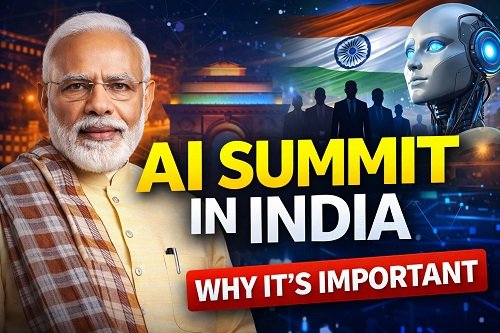
New Delhi is at the centre of a major global conversation this week. From February 16 to 20, 2026, India is hosting the AI Impact Summit, one of the largest international conferences on artificial intelligence ever held in a developing nation. The event is happening at Bharat Mandapam, a massive convention centre in the heart of India’s capital.
A Summit With Worldwide Participation
This summit is not a small meet-up. It brings together more than 20 heads of state, around 60 ministers, and over 500 global AI leaders, including CEOs, founders, researchers, and policymakers from all over the world. Governments and tech giants alike have sent top representatives.
Companies like Google, Microsoft, OpenAI, Amazon and Anthropic are among those present, showing just how seriously industry players view this event.
It’s also the first time a summit of this scale is taking place in the Global South — a term used for developing regions of the world. That matters because most major tech conferences have traditionally been held in the US, Europe, or East Asia. India’s role as host signals a shift in global tech influence.
What the Summit Aims to Do
The organisers have set some clear goals for this week:
● Shape global cooperation on AI policies, especially around safety, responsibility, and ethical use.
● Boost inclusive growth through AI, making sure technology can help countries with different levels of resources.
● Encourage investment and innovation in AI solutions that can benefit everyday people.
● Highlight workable AI applications, from education and healthcare to climate and governance.
India’s own leaders have stressed that AI must be developed for people and planet, not just profit. The summit’s agenda reflects that focus, with discussions on impacts like job disruption, child safety online, and social equity.
Who Is Here and What They’re Talking About
People in the rooms range from world leaders like French President Emmanuel Macron and Brazil’s president Luiz Inácio Lula da Silva, to top executives from the biggest AI labs and tech companies.
There are panels and talks on:
● AI regulation and global standards
● How AI can improve public systems
● Ways to protect jobs and skills in the age of automation
● Encouraging responsible innovation
● Partnerships between governments, industry and startups
Alongside the summit is an expo where startups, researchers and innovators are showing off real AI tools and technologies. Prime Minister Narendra Modi himself visited several booths and talked with founders and experts ahead of the summit’s official opening.
Challenges and Highlights
Not everything has been smooth. On the first day, some attendees reported long queues, crowding and confusion at entrances as security procedures were tightened ahead of high-level visits. Organisers are working to fix those logistical issues.
Still, the presence of world leaders and tech CEOs gives the summit a weight that few other events of this kind have had. It’s attracting huge attention from media, businesses and researchers around the world.
Innovation Meets Creativity
While serious discussions are happening in the conference halls, there’s also room for creativity. For example, the first AI Film Festival is being held alongside the summit. That event will explore how artificial intelligence can be used in storytelling and cinema, showing short films and creative works that blend art with technology.
India’s Role on the Global Stage
India is using this summit to frame itself not just as a user of AI technology, but as a key player in shaping global rules and priorities. Beyond investment and tools, the country is positioning itself as a voice for inclusive and responsible use of technology — especially for countries that don’t always get a say in global tech policy.
The summit also includes three Global Impact Challenges — competitions that invited thousands of applications from over 60 countries. The top 70 teams will showcase scalable AI solutions that aim to solve real problems.
Why It Matters
Artificial intelligence is not just a piece of code anymore. It’s shaping how societies work, how economies grow, and how nations compete. A summit like this, hosted in India with strong global participation, reflects how the technological center of gravity is shifting. Leaders are talking about more than breakthroughs and startups — they’re talking about governance, fairness, human impact, the future of work, and global cooperation.
Whether you are a student, professional, entrepreneur, or curious citizen, what comes out of this summit will influence how AI affects everyday life in the years ahead.

Satyakam is a seasoned professional content writer with over 15 years of experience in creating high-quality, research-driven content for digital platforms. He specialises in business, finance, banking, law, technology, and informational blogs.