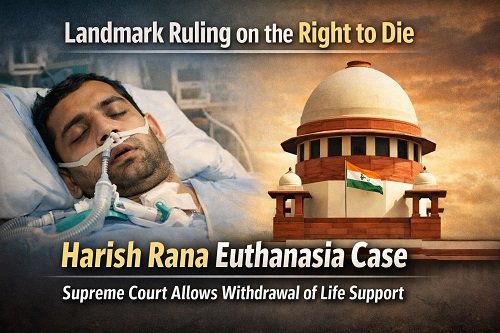
In a landmark and deeply emotional decision, the Supreme Court of India recently allowed the withdrawal of life support for Harish Rana, a 31-year-old man from Ghaziabad who had been living in a permanent vegetative state for more than 13 years. The ruling has reignited a nationwide debate on the right to die with dignity, medical ethics, and the limits of law in matters of life and death.
This judgment is being described as one of the most significant developments in India’s legal and ethical discussions on euthanasia.
The Tragic Story Behind the Case
Harish Rana’s life changed dramatically in August 2013 when he fell from the fourth floor of a building in Chandigarh while studying engineering. The accident caused severe brain injuries, leaving him in a permanent vegetative state with 100% disability.
Since then, he has remained bedridden, unable to move, speak, or communicate. He depended entirely on medical support and constant care from his family.
For over a decade, his parents struggled emotionally and financially to care for him. They reportedly sold their house and exhausted their savings to keep him alive. However, after years without any improvement, the family reached a heartbreaking conclusion: their son had no realistic chance of recovery.
Eventually, they approached the Supreme Court seeking permission for passive euthanasia — the withdrawal of life-sustaining treatment.
What the Supreme Court Decided
On March 11, 2026, the Supreme Court allowed the withdrawal of life support for Harish Rana. The court directed AIIMS in Delhi to admit him and supervise the medical process for withdrawing life-sustaining treatment under proper guidelines.
The judges emphasized that the decision was guided by compassion and medical evidence. A medical board had confirmed that Harish had almost no possibility of recovery, making continued treatment medically futile.
The verdict recognized that forcing someone to remain alive in such irreversible suffering may violate the principle of human dignity.
Understanding Passive Euthanasia
Euthanasia is often misunderstood, but there are two main types:
- Active Euthanasia
This involves intentionally administering drugs or other measures to cause death. It is illegal in India. - Passive Euthanasia
This means withdrawing life-sustaining treatment such as ventilators or feeding tubes when recovery is impossible.
India’s Supreme Court had already allowed passive euthanasia under strict conditions in the 2018 Common Cause judgment, which recognized the “right to die with dignity” as part of Article 21 (Right to Life) of the Constitution.
The Harish Rana case builds upon those guidelines and applies them in a real-life situation involving long-term medical suffering.
Why This Judgment Is So Important
This ruling is considered historic for several reasons.
1. Strengthening the Right to Die with Dignity
The judgment reinforces that the constitutional right to life also includes the right to a dignified death when survival becomes meaningless due to irreversible medical conditions.
2. Clearer Medical and Legal Procedures
The court directed that such decisions must involve medical boards, judicial supervision, and family consent to avoid misuse.
3. Renewed Debate on End-of-Life Laws
The Supreme Court also urged the central government to consider creating clear legislation on passive euthanasia, as India currently relies mainly on court guidelines rather than a comprehensive law.
Ethical Questions Raised by the Case
Despite the legal clarity, the case raises difficult moral questions.
Many people believe life must be preserved under all circumstances, regardless of suffering. Others argue that when recovery is impossible, allowing a peaceful death is more humane.
Doctors also face ethical dilemmas. Their oath is to save lives, yet they must also consider patient dignity and the reality of irreversible medical conditions.
Cases like Harish Rana’s highlight the emotional burden families carry when caring for a loved one with no hope of recovery.
Comparison with the Aruna Shanbaug Case
India’s euthanasia debate first gained major attention with the Aruna Shanbaug case, where a nurse remained in a vegetative state for over 40 years after a brutal assault.
In 2011, the Supreme Court allowed passive euthanasia under strict supervision in that case. Later, in 2018, the court formally recognized living wills, allowing individuals to specify end-of-life treatment preferences.
The Harish Rana verdict continues this legal evolution.
The Human Side of the Judgment
Beyond legal arguments and medical reports lies the painful reality faced by Rana’s parents. For 13 years they cared for a son who could not speak, move, or recognize them.
Their plea for euthanasia was not driven by neglect but by deep emotional exhaustion and the belief that their son deserved peace.
The Supreme Court acknowledged this human dimension while delivering its verdict.
Conclusion
The Harish Rana euthanasia case marks a significant moment in India’s legal history. It highlights the delicate balance between preserving life and respecting human dignity.
While the judgment does not legalize active euthanasia, it strengthens the framework for passive euthanasia under strict safeguards.
More importantly, it forces society to confront difficult questions about suffering, compassion, and the meaning of dignity at the end of life.
As India continues to debate these issues, the Rana case will likely remain a defining reference point in discussions about the right to die with dignity.

Satyakam is a seasoned professional content writer with over 15 years of experience in creating high-quality, research-driven content for digital platforms. He specialises in business, finance, banking, law, technology, and informational blogs.