
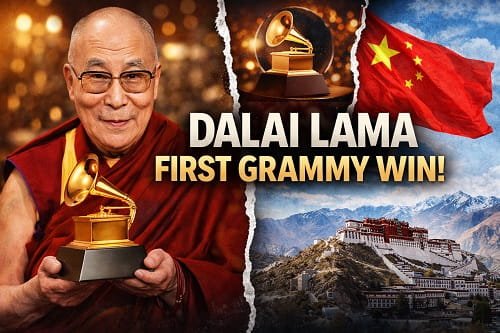
At 90 years old, His Holiness the 14th Dalai Lama made Grammy history. The Tibetan spiritual leader won his first Grammy Award at the 68th Annual Grammy Awards in Los Angeles, in the category of Best Audio Book, Narration & Storytelling Recording. His spoken-word project Meditations: The Reflections of His Holiness the Dalai Lama triumphed over work by other notable nominees, bringing messages of peace and compassion to a global audience in a way that transcends conventional music awards.
An Unexpected Grammy Win
The Grammy Awards are traditionally a celebration of musical artistry, yet at the 2026 ceremony, one of the biggest stories was the Dalai Lama’s victory. His album Meditations: The Reflections of His Holiness the Dalai Lama won in the spoken-word category — a field that honours excellence in narration and storytelling rather than song.
This win marks the first time the Dalai Lama — known globally as a spiritual leader and advocate for peace — has been honored by the National Academy of Recording Arts and Sciences. At age 90, he added the Grammy to a long list of accolades, including the Nobel Peace Prize and the U.S. Presidential Medal of Freedom.
The Grammy was accepted by Rufus Wainwright, a collaborator on the project, who humorously noted that he was “not the Dalai Lama” before highlighting the honour of representing such a profound body of work.
What Meditations Is All About
Meditations isn’t a typical music album. It blends the Dalai Lama’s spoken reflections on life, compassion, peace, environmental care, and human connection with subtle musical elements and contributions from celebrated artists.
The project draws inspiration from years of talks and teachings, turned into an immersive audio experience that invites listeners to reflect rather than just listen. Its tracks touch on universal themes — from Peace to Care for the Planet — echoing the values that have defined the Dalai Lama’s public life for decades.
The album stood out among other nominees like comedian Trevor Noah and U.S. Supreme Court Justice Ketanji Brown Jackson, illustrating how storytelling and contemplation can resonate just as strongly as musical performance in today’s cultural landscape.
A Moment for Global Reflection
After the win, the Dalai Lama released a statement saying the Grammy wasn’t a personal achievement but rather a recognition of shared universal responsibility. He framed the honour as something that belongs to all who strive for compassion and unity in a fractured world.
For many observers, the win was more than an award. It served as a reminder that platforms like the Grammy stage can elevate voices of peace and mindfulness alongside mainstream entertainment. The message wasn’t lost on fans around the world, especially those in the Tibetan exile community based in Dharamshala, India, where the Dalai Lama has lived since fleeing Tibet in 1959.
China’s Reaction and Political Undercurrents
Not everyone welcomed the recognition. The Chinese government issued strong criticism of the Grammy decision, denouncing it as politically motivated and accusing the Dalai Lama of engaging in separatist activities under the guise of religion. Chinese officials called the award a form of “anti-China political manipulation.”
Tibet has been under Chinese control since the early 1950s, and the Dalai Lama’s exile has been a point of prolonged tension. Beijing insists it holds authority over the succession of spiritual leaders, while the Dalai Lama has maintained that his successor will be chosen independently of Chinese influence. This backdrop adds another layer to the Grammy win, making it not just an artistic milestone, but also a symbol in an ongoing geopolitical narrative.
Why This Moment Matters
The Dalai Lama’s Grammy win is a rare blend of spirituality and popular culture. Music awards have historically celebrated rhythm, melody, and performance — yet here was a 90-year-old monk being honoured for his reflections on life and humanity. That contrast highlights how cultural boundaries are evolving.
His Grammy victory stands alongside other first-time winners of the night, including filmmaker Steven Spielberg and K-pop artists who also made history. Together, these wins reflect a broader shift in how the Recording Academy recognizes creative expression — embracing a diversity that extends well beyond traditional genres.
For billions of people around the globe who follow the Dalai Lama’s teachings, the Grammy is a milestone that amplifies his message of connectedness. And for many who may never have heard his teachings before, this Grammy could be an invitation — a way to pause, listen, and reflect on what truly matters.

Satyakam is a seasoned professional content writer with over 15 years of experience in creating high-quality, research-driven content for digital platforms. He specialises in business, finance, banking, law, technology, and informational blogs.