
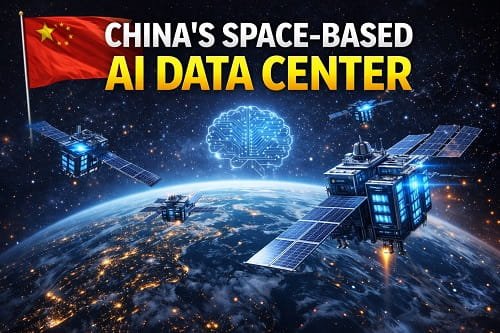
China is preparing for something that still sounds like science fiction: artificial-intelligence data centers in space.
Yes — real servers, running AI workloads, orbiting Earth.
The idea surfaced in recent reports carried by Reuters and later picked up by Indian and global media. According to the plan, China wants to begin deploying space-based AI data centers within the next five years, creating what officials describe as a kind of “orbital cloud.”
It’s ambitious. It’s expensive. And if it works, it could quietly reshape how the world handles computing power.
Let’s break it down.
What exactly is China building?
At the center of this project is China’s state aerospace giant China Aerospace Science and Technology Corporation. The company has outlined a roadmap for launching clusters of satellites equipped with computing hardware, storage systems, and AI processors.
Instead of sending raw satellite data back to Earth for analysis, these orbital platforms would process information directly in space.
Think of it as a floating server farm.
These space data centers would handle:
- AI calculations
- cloud storage
- satellite imaging analysis
- communications routing
- edge computing for global networks
All powered largely by solar energy.
Why put data centers in space?
Traditional AI data centers on Earth consume massive electricity and water for cooling. As AI grows, so does the strain on power grids.
Space offers a few surprising advantages:
1. Solar power is constant
Orbiting platforms can harvest uninterrupted sunlight, reducing dependence on terrestrial energy.
2. Natural cooling
The vacuum of space allows heat to dissipate more efficiently than crowded land facilities.
3. Faster satellite processing
Earth-observation satellites generate enormous data. Processing it in orbit avoids delays and bandwidth limits.
4. Strategic independence
Countries don’t need undersea cables or foreign infrastructure. Everything stays above national control.
For China, this fits neatly into its long-term push for technological self-reliance.
This isn’t just about technology — it’s geopolitics
China’s move also signals a new phase in the global tech race.
Space is becoming the next battleground for digital infrastructure.
The United States and private companies are already exploring similar ideas. SpaceX, led by Elon Musk, has openly discussed launching solar-powered orbital computing platforms in the future. Several Western firms are studying space-based cloud systems as well.
But China appears to be the first major nation attempting a coordinated, government-backed rollout.
If successful, it could give Beijing an early lead in space computing — a field many experts believe will underpin future AI, satellite internet, and defense systems.
How soon could this become real?
Officials suggest early deployments could happen before 2030, starting with smaller experimental platforms and gradually scaling up.
Large-scale orbital data centers will take time. There are serious challenges:
- Radiation damages electronics
- Repairs in orbit are difficult
- Launch costs remain high
- Space debris is a growing risk
- Hardware must survive extreme temperature swings
Most analysts expect modest prototypes first, followed by slow expansion through the 2030s.
Still, even a limited system would be a historic first.
Why this matters for everyday people
At first glance, orbital data centers feel distant from daily life. But the impact could be huge.
If space AI becomes practical, it could influence:
- global internet speeds
- weather forecasting
- disaster monitoring
- navigation systems
- climate research
- autonomous vehicles
- future AI services
It may also change where computing power lives — shifting part of the world’s digital backbone off Earth.
That’s not a small shift.
The bigger picture
For decades, space was about exploration.
Now it’s about infrastructure.
China’s plan shows how satellites are evolving from simple observation tools into active computing platforms. Instead of just collecting data, space systems will analyze, decide, and act in real time.
It’s a quiet transformation — but a profound one.
Whether this vision succeeds or struggles, one thing is clear: the future of AI won’t be limited to server rooms on Earth. Parts of it will live in orbit, powered by sunlight, circling silently above us.
And that future may arrive sooner than most people expect.

Satyakam is a seasoned professional content writer with over 15 years of experience in creating high-quality, research-driven content for digital platforms. He specialises in business, finance, banking, law, technology, and informational blogs.