
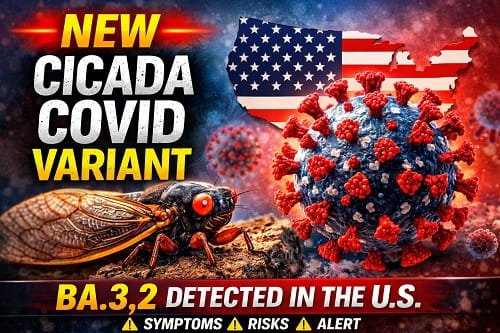
The COVID-19 story is far from over. Just when things seemed quieter, a new variant has stepped into the spotlight. It’s called BA.3.2, but most people are calling it the “Cicada” variant—a name inspired by how it stayed hidden for a long time and then suddenly reappeared.
This variant has now been detected in the United States and several other countries. Naturally, people are asking the same questions again: Is it dangerous? Are symptoms different? Should we be worried?
Let’s break it down in a simple, clear way.
What Is the BA.3.2 “Cicada” Variant?
BA.3.2 is a subvariant of the Omicron strain of COVID-19. It actually comes from an older Omicron lineage (BA.3) that had almost disappeared earlier in the pandemic.
What makes this variant stand out is its high number of mutations—especially in the spike protein, which the virus uses to enter human cells. Scientists say it carries over 70 mutations, which is unusually high.
It was first detected in South Africa in late 2024, but didn’t spread widely until 2025.
The World Health Organization has labeled it a “variant under monitoring”, meaning it’s not a major global threat yet, but it’s being watched closely.
Where Has It Been Found?
BA.3.2 has now spread to more than 20 countries, including the United States, parts of Europe, and Australia.
In the U.S., it was first detected in a traveler passing through San Francisco. Since then, it has been found in:
- Clinical samples
- Wastewater surveillance
- Multiple states (around 25 states reported detection)
Despite this spread, it still accounts for less than 1% of total cases in the U.S., so it’s not dominant yet.
Why Are Experts Paying Attention?
The main concern is not how deadly it is—but how it behaves.
Here are the key reasons experts are watching it closely:
- High mutation count:Could make it more adaptable
- Immune escape potential:May partially bypass immunity from vaccines or past infection
- Possible higher spread:Early signs suggest it might spread more easily
However, there is no solid evidence yet that it causes more severe illness than earlier Omicron variants.
That’s important. High mutation doesn’t always mean more danger—it often just means more unpredictability.
Symptoms of the BA.3.2 Variant
So far, symptoms look very similar to previous COVID-19 variants. There’s nothing dramatically new.
Common symptoms include:
- Fever or chills
- Cough
- Sore throat
- Fatigue
- Headache
- Body aches
- Runny or blocked nose
- Loss of taste or smell
- Shortness of breath (in some cases)
In many cases, symptoms are described as mild or flu-like, especially in vaccinated individuals.
Like earlier variants, some people may have no symptoms at all.
Risk Factors: Who Should Be Careful?
Even though BA.3.2 doesn’t appear more severe, certain groups still need to be cautious.
Higher-risk groups include:
- Elderly individuals
- People with chronic illnesses (diabetes, heart disease, lung issues)
- Immunocompromised individuals
- Unvaccinated people
For these groups, even a mild variant can become serious.
Do Vaccines Still Work?
Yes—this is one of the most reassuring points.
Even though BA.3.2 may partially evade immunity, current COVID vaccines are still expected to protect against severe illness, hospitalization, and death.
That means vaccines may not fully stop infection, but they still reduce risk significantly.
Experts continue to recommend:
- Staying updated with boosters
- Wearing masks in crowded places (if needed)
- Testing if symptoms appear
Could This Variant Cause a New Wave?
Right now, it’s too early to say.
Some scientists believe BA.3.2 could contribute to a future surge, especially if it spreads faster or escapes immunity more effectively.
But others point out:
- Its current share of cases is still very low
- No major spike in hospitalizations has been linked to it
So, the situation is being monitored, not panicked over.
What Should You Do Now?
There’s no need for fear, but staying alert makes sense.
Simple steps still work:
- Wash hands regularly
- Avoid close contact if you feel sick
- Get tested if symptoms appear
- Stay home if positive
- Seek medical help if symptoms worsen
These are the same basics we’ve followed for years—and they still hold up.
Final Thoughts
The BA.3.2 “Cicada” variant is a reminder of something we already know: viruses keep evolving.
But here’s the key takeaway—so far, this variant is not showing signs of being more dangerous, even though it has many mutations.
It may spread more easily. It may dodge immunity a bit. But vaccines still work, and symptoms remain largely mild for most people.
In simple terms:
Stay aware, not afraid.

Satyakam is a seasoned professional content writer with over 15 years of experience in creating high-quality, research-driven content for digital platforms. He specialises in business, finance, banking, law, technology, and informational blogs.